Robert Moreland Faloon
Robert Moreland Faloon's family, friends, journalists, Penn Staters, Rotarians, sports enthusiasts, fellow actors, and runners mourn the loss of 'Rube' who passed away on December 17, 2007 of congestive heart failure at the age of 85.
He had a long and creative career in journalism starting as a paper boy in Mt. Lebanon in Pittsburgh where he was born February 10, 1922. His interest continued in high school and college as editor of the school newspapers, Journalism school at Penn State, followed by reporter, editor, managing editor, sales and circulation, sales and research director where he developed many new and innovated ways to promote newspaper readership and civic involvement. He finished his career at the Akron Beacon Journal after more than 15 years of service. He also worked for the Houston Post, Coral Gables Times, Oak Ridger (Tenn), Pompano Beach Town News (Fla.), and The Lancaster (Pa), among others. While working in Tennessee Rube was honored to be asked by Al Gore, Sr. to head up Gore's first Senate campaign, but had to decline at the time due to family obligations. While at Penn State he was elected President of his senior class in 1943 but his term was interrupted by his enlistment in the Army. He also was a member of Lions Paw and ran cross country at Penn State where he competed at the Penn Relays and the Boston marathon, finally graduating in 1946 after the war. His World War ll service as a staff supply sergeant for the artillery in the Philippines was preceded by Russian language Studies for the Army Intelligence. He received three bronze stars. Rube also continued his running in the 1950's, organized many road races long before jogging became popular, and continued running well into his 70's. Rube's dedication to community service led him to be a life long Rotarian serving as president of many of his local chapters, as well as on the board of Rotary International, where he was very active in polio eradication and many trips abroad including Australia, Russia, Ireland, England, Belize, both in service and pleasure. He also served on the board of 'Up with People'. He also came out of retirement to volunteer as Director of the Census for a five county district including the Cleveland area. Rube was married twice for over 25 years each.
He is survived by his first wife, Mary Boyd which ended in divorce; his children, Jean Faloon, Kathryn Faloon, Kelly Faloon, Trudy Faloon, William Faloon, and a foster son, Richard Woolcock who Rube and Mary helped immigrate to The United States from Belize in 1956. He is also survived by his grandchildren, Orion Koller-Faloon, Brooke Koller-Faloon, Arial Koller-Faloon, and John Faloon. His second wife, a very distant relative, was Virginia Faloon now deceased.
[Beacon Journal, Akron, OH,Tuesday, March 11, 2008, page B6, col. 1]
Tuesday, March 11, 2008


Robert Thomas dies at 84
Robert W. "Billy" Thomas, 84, formerly of Koerber St., Akron, died Saturday, March 8, 2008 at Traditions on Bath Road.
He was born on April 25, 1923 in Akron, the son of Benjamin and Margaret Thomas. On November 16, 196 3, he married Delphine Jennings Cramner. She preceded him in death on August 23, 1990. He retired from the Akron Beacon Journal in 1987 with 44 years of service.
Bob is survived by his stepdaughter, Barbara (Gregory) Putman, stepgrandchildren, stepgreat-grandchildren and other relatives and friends.
Thank you to the nurses at Traditions and the Visiting Nurses for their loving care.
A Funeral Service will be conducted at 2 p.m. Wednesday in The Clifford-Shoemaker Funeral Home, 1930 Front St., Cuyahoga Falls, Rev. Vincent Lamb officiating. Friends may call beginning at 1 p.m. Wednesday. Interment at Northlawn Memorial Gardens.
[Beacon Journal, Akron, OH,Tuesday, March 11, 2008, page B7, col. 3]
He was born on April 25, 1923 in Akron, the son of Benjamin and Margaret Thomas. On November 16, 196
 3, he married Delphine Jennings Cramner. She preceded him in death on August 23, 1990. He retired from the Akron Beacon Journal in 1987 with 44 years of service.
Bob is survived by his stepdaughter, Barbara (Gregory) Putman, stepgrandchildren, stepgreat-grandchildren and other relatives and friends.
Thank you to the nurses at Traditions and the Visiting Nurses for their loving care.
A Funeral Service will be conducted at 2 p.m. Wednesday in The Clifford-Shoemaker Funeral Home, 1930 Front St., Cuyahoga Falls, Rev. Vincent Lamb officiating. Friends may call beginning at 1 p.m. Wednesday. Interment at Northlawn Memorial Gardens.
[Beacon Journal, Akron, OH,Tuesday, March 11, 2008, page B7, col. 3]
Sunday, March 09, 2008
Ed Suba's photo tells the story

A solitary figure makes his way up a deserted, snow-covered South High Street as heavy amounts of snow continues to fall on the five county area onSaturday, March 8, 2008, in Akron, Ohio.
(Ed Suba Jr./Akron Beacon Journal)

This photo by Ed Suba which appeared large on page A1 of Sunday's Beacon Journal tells the story of the 15 inches of snow that walloped Akron during the weekend. The Saturday total of 8.7 inches was in the top 10 snowfall records. It ranked No. 8 in a list topped by 19.7 inches on April 4, 1987. Remember that one?
Friday, March 07, 2008
San Jose Mercury News cuts 50 jobs
The Mercury News cut 50 jobs today through a combination of layoffs and buyouts, and named new business and editorial page editors to replace managers who accepted buyouts.
Barbara J. Marshman, associate editor, will replace Stephen E. Wright as editorial page editor. She is the first woman to hold that job at the Mercury News.
Deputy business editor Stephen R. Trousdale replaces Rebecca Salner as business editor.
The appointments were announced by Editor David J. Butler.
Fifteen newsroom employees and 19 employees from other parts of the paper were laid off today. Earlier in the week, 16 employees accepted buyout offers, five from the newsroom. The reductions represent a cut of about 5 percent for the newspaper.
BJ Art Department about 1978

Art Krummel provided this photo of the Beacon Journal Art Department around 1978. (Click on the photo to enlarge it for a better view)
Here is the note Art sent with it:
i found this old photo of the beacon art dept. dated around 1978 (based on the mickey mouse birthday card).
boy, that was a cramped little office and Joe and I still smoked (i might have just quit, not sure). I have no idea what the number one is doing on my chest. chuck is sitting in denny haas's chair and the desk in the foreground is where i sat.
Walt, Bud and Joe, of course are sitting behind myself and Chuck.
Chuck, Balogh, Derf and I still get together for a beer every now and then. We're even kicking around the idea of a show featuring "artists who used to work at the Beacon but don't anymore"
Thursday, March 06, 2008
Zieman named Kansas City Star publisher
The McClatchy Co. has named Mark Zieman as president and publisher of The Kansas City Star, effective Thursday, the Kansas City Business Journal reported.
Zieman had been editor of the newspaper since 1997 and has been interim publisher since Jan. 28, when Mac Tully stepped down to take a job at MediaNews Group Inc.

McClatchy, based in Sacramento, Calif., is the third-largest newspaper company in the United States, with 30 daily newspapers, about 50 nondailies, and direct marketing and direct-mail operations.
As of Feb. 29, The Star had 1,347 employees, of whom 1,037 are full time, McClatchy spokesman Peter Tira said. The paper has 290 newsroom employees.
Zieman said he hopes to name his successor as editor in four to six weeks.
"We have some strong internal candidates, and that's always good and comforting," he said. "I've already been approached by a lot of people outside the paper who want to come here as editor."
Zieman was sanguine about the future for The Star and daily newspapers in general.
"I think newspapers probably do an overzealous job of talking about the challenges of newspapers," he said. "All media have a lot of challenges. The great paradox of newspapers is that we've never been more popular with our readers. When you add in the online arm, .... we grew it by more than 7 million unique visitors in 2007 from 2006. Our readership in print and online combined is more than 3 million a month. We're a million a month in print alone. We've never had that in the 127 years of our history."
Click on the headline to read the story in the Business Journal.
Zieman had been editor of the newspaper since 1997 and has been interim publisher since Jan. 28, when Mac Tully stepped down to take a job at MediaNews Group Inc.

McClatchy, based in Sacramento, Calif., is the third-largest newspaper company in the United States, with 30 daily newspapers, about 50 nondailies, and direct marketing and direct-mail operations.
As of Feb. 29, The Star had 1,347 employees, of whom 1,037 are full time, McClatchy spokesman Peter Tira said. The paper has 290 newsroom employees.
Zieman said he hopes to name his successor as editor in four to six weeks.
"We have some strong internal candidates, and that's always good and comforting," he said. "I've already been approached by a lot of people outside the paper who want to come here as editor."
Zieman was sanguine about the future for The Star and daily newspapers in general.
"I think newspapers probably do an overzealous job of talking about the challenges of newspapers," he said. "All media have a lot of challenges. The great paradox of newspapers is that we've never been more popular with our readers. When you add in the online arm, .... we grew it by more than 7 million unique visitors in 2007 from 2006. Our readership in print and online combined is more than 3 million a month. We're a million a month in print alone. We've never had that in the 127 years of our history."
Click on the headline to read the story in the Business Journal.
Newspaper finds luck of the Irish
Hey, March is Irish-American Heritage Month (proclaimed by Congree is 1955) so it’s time for a report from the Irish Examiner.
The newspaper reports IRISH daily newspaper readership continues to grow — with the Irish Examiner adding 18,000 readers a day over the past year, and 60,000 a day over the past five years.
While the media landscape has never been so competitive, and with many predicting the demise of newspapers because of various new media, almost nine out of 10 people still read a national newspaper, according to the latest Joint National Readership Survey , from January to December 2007.
Three million readers choose to read a newspaper on a daily basis, the survey found.
The newspaper reports IRISH daily newspaper readership continues to grow — with the Irish Examiner adding 18,000 readers a day over the past year, and 60,000 a day over the past five years.
While the media landscape has never been so competitive, and with many predicting the demise of newspapers because of various new media, almost nine out of 10 people still read a national newspaper, according to the latest Joint National Readership Survey , from January to December 2007.
Three million readers choose to read a newspaper on a daily basis, the survey found.
Tuesday, March 04, 2008
Slate is Watching McClatchy
Slate , the daily magazine on the Web.founded in 1996 by the Washington Post, on Monday put up the first of a series by Jack Shafer called Watching McClatchy
The headline asks:
As a leading indicator of the newspaper biz's health, what does the chain's bad news portend for the rest of the industry?
Here’s the lead:
Just two years ago, McClatchy Co. President and CEO Gary Pruitt boasted the sunniest disposition of all newspaper executives. In a Wall Street Journal op-ed, he toasted newspapers as "still among the best media businesses" as his firm's purchase of the Knight Ridder chain tripled its print holdings.
Pruitt conceded that newspaper advertising had peaked in 2000, but he maintained that no competitors in local markets had held their audiences as well as newspapers. Far from being a "dying industry," wrote Pruitt, the newspapers were adding the "unduplicated reach of newspaper Web sites to newspaper readership" to grow their audiences.
Since Pruitt's declaration, McClatchy stock has fallen, fallen, and then fallen some more. It's dropped about 75 percent in the past year and is now trading at less than $10. Last week, the McClatchy-owned Sacramento Bee reported that the company is taking a $1.47 billion write-down, this following a similar $1.37 billion write-down in November.
Essentially, the write-downs are McClatchy's way of acknowledging under accounting rules that it paid way too much for Knight Ridder, that its stock price has vaporized, and that advertising has croaked. McClatchy's January ad revenue dropped about 16 percent over the previous year, a company press release reports. Real estate ads are off 34 percent and employment ads—a bigger business—fell 30 percent.
By scrutinizing McClatchy's agonies, I don't mean to rub Pruitt's nose in his optimistic 2006 op-ed. His reputation as one of the nation's best and most creative newspaper executives makes his chain a leading indicator of the newspaper future. Other chains are experiencing similar downturns, but McClatchy isn't just another chain. It's supposed to be smarter and more nimble than the rest, but is it? Did Pruitt show bad geographical judgment by overinvesting in the wrong markets at the wrong time? He bulked up on real-estate-driven economies, adding newspapers in Florida and the Sun Belt, just as those places were about to decline. He doubled down on newspapers just as newspaper's core advertisers—real estate, finance, job listings—were opting out for Web alternatives.
Pruitt must somehow reference his Journal op-ed and admit that he was wrong about his industry's prospects and then explain what he's going to do to rectify his error. He bought Knight Ridder at the peak of the housing bubble and obviously didn't foresee the subprime crisis. In that regard, he's not alone. The subprime monster has trashed real estate ad revenue in California and Florida, home to some of the chain's biggest papers. "Revenue from California and Florida operations dropped more than 20 percent," the Bee reports. Newspapers have traditionally been patient about riding out advertising downturns, but the subprime disaster may make this downturn an abyss for McClatchy's most affected newspapers.
As Alan D. Mutter noted in his Newsosaur blog last month, Pruitt mistakenly jettisoned the Knight Ridder newspapers in Akron, Ohio; Philadelphia; and the Dakotas in favor of the hot-house Sun Belt properties. Pruitt's plan to grow the Web side of McClatchy as advertisers migrate there, sketched briefly in the Journal op-ed, didn't work out, as Mutter reported in another post last September. "With industry-wide online sales up 20.8 percent in the first half of this year, McClatchy's interactive revenues gained a meager 1.4 percent through June, according to the company," he writes.
Click on the headline to read it all and then remember where you were because we may not have room for future posts in the series.
The headline asks:

As a leading indicator of the newspaper biz's health, what does the chain's bad news portend for the rest of the industry?
Here’s the lead:
Just two years ago, McClatchy Co. President and CEO Gary Pruitt boasted the sunniest disposition of all newspaper executives. In a Wall Street Journal op-ed, he toasted newspapers as "still among the best media businesses" as his firm's purchase of the Knight Ridder chain tripled its print holdings.
Pruitt conceded that newspaper advertising had peaked in 2000, but he maintained that no competitors in local markets had held their audiences as well as newspapers. Far from being a "dying industry," wrote Pruitt, the newspapers were adding the "unduplicated reach of newspaper Web sites to newspaper readership" to grow their audiences.
Since Pruitt's declaration, McClatchy stock has fallen, fallen, and then fallen some more. It's dropped about 75 percent in the past year and is now trading at less than $10. Last week, the McClatchy-owned Sacramento Bee reported that the company is taking a $1.47 billion write-down, this following a similar $1.37 billion write-down in November.
Essentially, the write-downs are McClatchy's way of acknowledging under accounting rules that it paid way too much for Knight Ridder, that its stock price has vaporized, and that advertising has croaked. McClatchy's January ad revenue dropped about 16 percent over the previous year, a company press release reports. Real estate ads are off 34 percent and employment ads—a bigger business—fell 30 percent.
By scrutinizing McClatchy's agonies, I don't mean to rub Pruitt's nose in his optimistic 2006 op-ed. His reputation as one of the nation's best and most creative newspaper executives makes his chain a leading indicator of the newspaper future. Other chains are experiencing similar downturns, but McClatchy isn't just another chain. It's supposed to be smarter and more nimble than the rest, but is it? Did Pruitt show bad geographical judgment by overinvesting in the wrong markets at the wrong time? He bulked up on real-estate-driven economies, adding newspapers in Florida and the Sun Belt, just as those places were about to decline. He doubled down on newspapers just as newspaper's core advertisers—real estate, finance, job listings—were opting out for Web alternatives.
Pruitt must somehow reference his Journal op-ed and admit that he was wrong about his industry's prospects and then explain what he's going to do to rectify his error. He bought Knight Ridder at the peak of the housing bubble and obviously didn't foresee the subprime crisis. In that regard, he's not alone. The subprime monster has trashed real estate ad revenue in California and Florida, home to some of the chain's biggest papers. "Revenue from California and Florida operations dropped more than 20 percent," the Bee reports. Newspapers have traditionally been patient about riding out advertising downturns, but the subprime disaster may make this downturn an abyss for McClatchy's most affected newspapers.
As Alan D. Mutter noted in his Newsosaur blog last month, Pruitt mistakenly jettisoned the Knight Ridder newspapers in Akron, Ohio; Philadelphia; and the Dakotas in favor of the hot-house Sun Belt properties. Pruitt's plan to grow the Web side of McClatchy as advertisers migrate there, sketched briefly in the Journal op-ed, didn't work out, as Mutter reported in another post last September. "With industry-wide online sales up 20.8 percent in the first half of this year, McClatchy's interactive revenues gained a meager 1.4 percent through June, according to the company," he writes.
Click on the headline to read it all and then remember where you were because we may not have room for future posts in the series.
Is the TV news giving in to sexism?
Is the TV news giving in to sexism?
That’s the question asked by CNN’s Carol Costello in an interesting piece by Rich Heldenfels jn a nice piece on Page2 of today’s Beacon Journal.
Here’s just one quote:
''After we did a lot on Anna Nicole Smith, we felt dirty. We did. We had a meeting and a discussion about that, and we told ourselves . . . we were never going to do that again. And we haven't. We do news. Even when it's not the great, interesting, political time, we do the news.''
Regarding image, she recalled recently seeing a man and woman anchoring the news. The man was in a dark suit. The woman, Costello said, ''was wearing, I swear to you, a skirt so short she did not dare uncross her legs. . . .
''I found myself unable to pay attention to what she was talking about because I was completely mesmerized by her skirt,'' said Costello. She wondered if the woman had been told by her boss to wear the skirt, or if she was simply giving in to sexism.
''Our culture seems to be saying sex is power,'' she said. Even older women, she said, have been called ''cougars,'' on the prowl for younger men. ''Desperate housewives'' still have to be sexy.
Click on the headline to read it all.
That’s the question asked by CNN’s Carol Costello in an interesting piece by Rich Heldenfels jn a nice piece on Page2 of today’s Beacon Journal.

Here’s just one quote:
''After we did a lot on Anna Nicole Smith, we felt dirty. We did. We had a meeting and a discussion about that, and we told ourselves . . . we were never going to do that again. And we haven't. We do news. Even when it's not the great, interesting, political time, we do the news.''
Regarding image, she recalled recently seeing a man and woman anchoring the news. The man was in a dark suit. The woman, Costello said, ''was wearing, I swear to you, a skirt so short she did not dare uncross her legs. . . .
''I found myself unable to pay attention to what she was talking about because I was completely mesmerized by her skirt,'' said Costello. She wondered if the woman had been told by her boss to wear the skirt, or if she was simply giving in to sexism.
''Our culture seems to be saying sex is power,'' she said. Even older women, she said, have been called ''cougars,'' on the prowl for younger men. ''Desperate housewives'' still have to be sexy.
Click on the headline to read it all.
Rx note from Bob Abbott
Just got final paperwork Saturday on a hopeful new angle in regard to our situation. The trial balloon went well for me personally (in other words the personal medical mess I was thrown into) in regard to Medicare parts A & B but it appears we can't blame the BJ for this snafu that developed ultimately as a result of our being "forced" to sign up for Aetna's/Medicare part D. Not sure but I think it was Aetna's screwup and partially Medicare.
Bottom line...we're in a holding pattern. I tried to talk to counsel yesterday but he wasn't in. He wanted me to contact him once the dust settled in regard to the above situation. I'm heading to Utah for a week of skiing later today so I'll have to get in touch with him after that.
Then I will be able to spell out where we're at and the direction I believe we should go. And then I'll also find out if counsel is charging us for the last few phone conferences (I think (hope) not). We still have a small amount of cash left and I'll be giving an accounting of that as I find out if we have further legal bills coming in.
We're not dead yet...there are still some options which I will describe and will give an explanation of exactly where we are at now.
thanks for your patience...
bob abbott
Bottom line...we're in a holding pattern. I tried to talk to counsel yesterday but he wasn't in. He wanted me to contact him once the dust settled in regard to the above situation. I'm heading to Utah for a week of skiing later today so I'll have to get in touch with him after that.
Then I will be able to spell out where we're at and the direction I believe we should go. And then I'll also find out if counsel is charging us for the last few phone conferences (I think (hope) not). We still have a small amount of cash left and I'll be giving an accounting of that as I find out if we have further legal bills coming in.
We're not dead yet...there are still some options which I will describe and will give an explanation of exactly where we are at now.
thanks for your patience...
bob abbott
Monday, March 03, 2008
Memorable Story: To an athlete who does much more
This blog occasionally posts Memorable Stories from either the past or the present.
This one was written by Frank Aceto, associate sports editor of the Tallmadge Express . It is a story of a young athlete of many admirable accomplishments whose father, a former emplpye of the Beacon Journal circulation department who is awaiting a kidney transplant, and whose mother who has just completed chemo treatment for breast cancer.
Click here to meet Jon Lampley, Jonathon Sr. and Rebekah of Tallmadge. . It’s a memorable story by Aceto. Beacon Journal sports writer David Lee Morgan Jr. also write a fine article on Lampley on Feburary 21. It follows Aceto's story on our website.
And so we do not get sued for plagiarism or copyright violation, our very sincere thanks to the Tallmadge Express for publishing a great story.
This one was written by Frank Aceto, associate sports editor of the Tallmadge Express . It is a story of a young athlete of many admirable accomplishments whose father, a former emplpye of the Beacon Journal circulation department who is awaiting a kidney transplant, and whose mother who has just completed chemo treatment for breast cancer.
Click here to meet Jon Lampley, Jonathon Sr. and Rebekah of Tallmadge. . It’s a memorable story by Aceto. Beacon Journal sports writer David Lee Morgan Jr. also write a fine article on Lampley on Feburary 21. It follows Aceto's story on our website.
And so we do not get sued for plagiarism or copyright violation, our very sincere thanks to the Tallmadge Express for publishing a great story.
Saturday, March 01, 2008
Philadelphia Newspapers Lays off 68
Philadephia Newspapers laid off 68 Guild members Feburry 27 from the advertising, circulation, customer service, finance, marketing and systems departments, a Newspaper Guild news release announced,
This amounts to almost 10 percent of the union’s membership. Company officials said that a very small number of managers would be laid off.
“If the revenue is not there, then we have to cut expenses,” Michael Lorenca, executive vice president of Human Resources, told Guild officers. He said he did not know how much savings would result from the layoffs.
The layoff is effective March 28. However, the Company has told members to leave today and plans to reassign their work to surviving staff.
The Guild will begin working with the company to establish which of the laid off have bumping rights into other positions.
Under our contract, employees may volunteer to be laid off. The company has said it will consider such offers.
This amounts to almost 10 percent of the union’s membership. Company officials said that a very small number of managers would be laid off.
“If the revenue is not there, then we have to cut expenses,” Michael Lorenca, executive vice president of Human Resources, told Guild officers. He said he did not know how much savings would result from the layoffs.
The layoff is effective March 28. However, the Company has told members to leave today and plans to reassign their work to surviving staff.
The Guild will begin working with the company to establish which of the laid off have bumping rights into other positions.
Under our contract, employees may volunteer to be laid off. The company has said it will consider such offers.
McClatchy takes $1.47 billion write-down
This story appeared appeared in BUSINESS section, Page D1, of the Sacramento Bee
By Dale Kasler / Sacramento Bee
The McClatchy Co. announced another big write-down of its assets Thursday, this one totaling nearly $1.5 billion, a sign of a difficult business climate and the drop in McClatchy's stock price.
The $1.47 billion post-tax write-down was an accounting charge and won't actually cost Sacramento-based McClatchy any cash. But it's a reflection of the state of the newspaper industry and the troubles McClatchy has encountered since buying fellow publisher Knight Ridder Inc. in 2006.
Although The Bee's owner said it remains optimistic about its long-term future, the write-down signals a diminished value of the company's assets, especially the 20 papers acquired in the Knight Ridder deal.
The entire industry is suffering because of the real estate slump, a weakening economy and the migration of advertising and circulation to the Internet. McClatchy is particularly vulnerable because it gets one-third of its revenue from California and Florida, where the housing market is especially soft.
The write-down "reflects the downturn in advertising that has hit us, particularly in California and Florida," said McClatchy Treasurer Elaine Lintecum.
McClatchy absorbed a $1.37 billion non-cash write-down in November, mainly because of worsening business conditions.
The latest write-down became necessary almost entirely because of the decline in McClatchy's stock price.
Since the end of the third quarter of 2007, McClatchy shares have fallen roughly in half, and under accounting rules the company had to take another write-down.
The stock closed Thursday at $9.84, down 28 cents, on the New York Stock Exchange.
The write-down also reflects a dip in the market value of McClatchy's publicly traded bonds, plus the economy's "recessionary outlook," Chairman and Chief Executive Gary Pruitt said in a press release.
By Dale Kasler / Sacramento Bee
The McClatchy Co. announced another big write-down of its assets Thursday, this one totaling nearly $1.5 billion, a sign of a difficult business climate and the drop in McClatchy's stock price.
The $1.47 billion post-tax write-down was an accounting charge and won't actually cost Sacramento-based McClatchy any cash. But it's a reflection of the state of the newspaper industry and the troubles McClatchy has encountered since buying fellow publisher Knight Ridder Inc. in 2006.
Although The Bee's owner said it remains optimistic about its long-term future, the write-down signals a diminished value of the company's assets, especially the 20 papers acquired in the Knight Ridder deal.
The entire industry is suffering because of the real estate slump, a weakening economy and the migration of advertising and circulation to the Internet. McClatchy is particularly vulnerable because it gets one-third of its revenue from California and Florida, where the housing market is especially soft.
The write-down "reflects the downturn in advertising that has hit us, particularly in California and Florida," said McClatchy Treasurer Elaine Lintecum.
McClatchy absorbed a $1.37 billion non-cash write-down in November, mainly because of worsening business conditions.
The latest write-down became necessary almost entirely because of the decline in McClatchy's stock price.
Since the end of the third quarter of 2007, McClatchy shares have fallen roughly in half, and under accounting rules the company had to take another write-down.
The stock closed Thursday at $9.84, down 28 cents, on the New York Stock Exchange.
The write-down also reflects a dip in the market value of McClatchy's publicly traded bonds, plus the economy's "recessionary outlook," Chairman and Chief Executive Gary Pruitt said in a press release.
Thursday, February 28, 2008
Times-Reporter increases type size.
Welcome to your new Times-Reporter was the headline across the bottom of page 1 in the New Philadelphia-Dover Times Reporter. Here is the note to readers from the publisher and editor.

Dear Readers,
Despite today’s wintry ways, there’s a little springtime in our step.
We’re sporting a new look, one that we think is a perfect fit for these modern times.
The process that we began last fall concludes today with a new, easier-to-read presentation, including a larger text size for our stories.
We’ve also splashed some color onto our updated logo and added new content, including a daily lifestyle section (Monday: Food; Tuesday: Health and Fitness; Wednesday: Seniors; Thursday: Travel; Friday: Arts and Leisure; and Saturday: Homeworks and Religion).
For the first time, you’ll see changes in our Sports section. We’re adding more columns and hooking up game statistics with their related stories to name just a few of the changes.
We think in time the new Times-Reporter will feel just as comfortable as the old one.
If you have a comment about our new look, e-mail us at editor@timesreporter.com. We’ll post a sampling of comments in the next installment of our online feature “Ask the Editor.”
If you have a comment about our new look, e-mail us at editor@timesreporter.com. We’ll post a sampling of comments in the next installment of our online feature “Ask the Editor.”
Regards,
Jac Clay, Publisher
Dick Farrell, Editor

Dear Readers,
Despite today’s wintry ways, there’s a little springtime in our step.
We’re sporting a new look, one that we think is a perfect fit for these modern times.
The process that we began last fall concludes today with a new, easier-to-read presentation, including a larger text size for our stories.
We’ve also splashed some color onto our updated logo and added new content, including a daily lifestyle section (Monday: Food; Tuesday: Health and Fitness; Wednesday: Seniors; Thursday: Travel; Friday: Arts and Leisure; and Saturday: Homeworks and Religion).
For the first time, you’ll see changes in our Sports section. We’re adding more columns and hooking up game statistics with their related stories to name just a few of the changes.
We think in time the new Times-Reporter will feel just as comfortable as the old one.
If you have a comment about our new look, e-mail us at editor@timesreporter.com. We’ll post a sampling of comments in the next installment of our online feature “Ask the Editor.”
If you have a comment about our new look, e-mail us at editor@timesreporter.com. We’ll post a sampling of comments in the next installment of our online feature “Ask the Editor.”
Regards,
Jac Clay, Publisher
Dick Farrell, Editor
Monday, February 25, 2008
Another BJ south reunion in Florida
By JOHN OLESKY
For our Feb. 8-23 stay on Siesta Key, off Sarasota, Florida, Paula and I had our usual reunion with former Beacon Journal folks.
Cecily and Terry Dray came from their Avon Park, Florida, home to our rental on Siesta Key. Terry gave up a day of golfing for the reunion. Terry has trimmed his golfing from nine to seven times a week. He eliminated a second 18 holes on Saturday and Sunday. Terry, of course, was the superb makeup man in Composing Room for those who can remember back that far in newspaper history.
Don Bandy, the rewrite man in the newsroom who made cub reporters look good (and some older ones, too), came from his Bradenton, Florida home. Don has been spending time in Naples with his brother and sister-in-law, who were hospitalized. Don lives in the same condo complex as his sister.
Dave and Gina White, also composing room expatriates, didn't make it this time. But Paula and I had a great time at their Venice, Florida, home in September, when we flew down for the University of South Florida football game in Tampa against the West Virginia Mountaineers.
We spent time recalling our BJ days and catching up on former BJ folks who have died in recent years. And doing a lot of laughing, since the BJ was a fun place to work in "the good ol' days."
After luxuriating in temperatures as high as 80 degrees on Siesta Key's beach, Paula and I returned to Ohio to find that we couldn't get the doors to my van opened, or the hatch, too, because vehicles don't do well sitting for 15 days in an airport parking lot when the temperature can't get above freezing. And then the battery died after we drove to our Columbus motel, requiring a 3 a.m. jump start by hotel personnel.
It was enough to make us want to hop another flight to Florida until the Ohio weather becomes tolerable.
This was our 20th trip together, from China to Turkey to Mexico to the Caribbean, in our 40 months together. But traveling will be put on hold till I recover from my Tuesday, Feb. 26, surgery for an artificial right knee.
For our Feb. 8-23 stay on Siesta Key, off Sarasota, Florida, Paula and I had our usual reunion with former Beacon Journal folks.
Cecily and Terry Dray came from their Avon Park, Florida, home to our rental on Siesta Key. Terry gave up a day of golfing for the reunion. Terry has trimmed his golfing
 from nine to seven times a week. He eliminated a second 18 holes on Saturday and Sunday. Terry, of course, was the superb makeup man in Composing Room for those who can remember back that far in newspaper history.
Don Bandy, the rewrite man in the newsroom who made cub reporters look good (and some older ones, too), came from his Bradenton, Florida home. Don has been spending time in Naples with his brother and sister-in-law, who were hospitalized. Don lives in the same condo complex as his sister.
Dave and Gina White, also composing room expatriates, didn't make it this time. But Paula and I had a great time at their Venice, Florida, home in September, when we flew down for the University of South Florida football game in Tampa against the West Virginia Mountaineers.
We spent time recalling our BJ days and catching up on former BJ folks who have died in recent years. And doing a lot of laughing, since the BJ was a fun place to work in "the good ol' days."
After luxuriating in temperatures as high as 80 degrees on Siesta Key's beach, Paula and I returned to Ohio to find that we couldn't get the doors to my van opened, or the hatch, too, because vehicles don't do well sitting for 15 days in an airport parking lot when the temperature can't get above freezing. And then the battery died after we drove to our Columbus motel, requiring a 3 a.m. jump start by hotel personnel.
It was enough to make us want to hop another flight to Florida until the Ohio weather becomes tolerable.
This was our 20th trip together, from China to Turkey to Mexico to the Caribbean, in our 40 months together. But traveling will be put on hold till I recover from my Tuesday, Feb. 26, surgery for an artificial right knee.
Say 'Goodbye' to the Albuquerque Tribune
The Albuquerque Tribune published its last issue on Saturday, February 23, 2008. Albuquerque is a difficult name to spell and the Tribune will be a difficult name for some to forget. It also is difficult to "Google" up an image of that last front page.
We have, however, posted on our website a farewell written by Phil Casaus, an Albuquerque native, who was editor of The Trib for 1,746 days until its end. And with pure sentiment we have included photo illustrations of the staff by the Tribune's Charlotte Hill.
Please click on the headline to take a look. And if any of you can find an image of that last front page, please send it to us.
We have, however, posted on our website a farewell written by Phil Casaus, an Albuquerque native, who was editor of The Trib for 1,746 days until its end. And with pure sentiment we have included photo illustrations of the staff by the Tribune's Charlotte Hill.
Please click on the headline to take a look. And if any of you can find an image of that last front page, please send it to us.
Sunday, February 24, 2008
BJ endorses Clinton, McCain
The Beacon Journal today endorsed Democrat Hillary Clinton and Republican John McCain for president.
Click on the headline to see the editorials.
Click on the headline to see the editorials.
Saturday, February 23, 2008
We passed 70,000 mark for viewers
We passed the 70,000 mark this week on the number of visitors to the BJ retirees blog. There were 675 visitors the past week or an average of 96 visitors a day which is down a wee bit since not much interesting has been available for posting. There have been 1,463 items posted.
How about sending us some into and photos on what you have been doing lately. You have BJ friends who have scattered from JSK land all over the world who would like to hear what you have been up to.lately.
How about sending us some into and photos on what you have been doing lately. You have BJ friends who have scattered from JSK land all over the world who would like to hear what you have been up to.lately.
Friday, February 22, 2008
Zaidan featured on BJ politics Video of the Day
Retired Beacon Journal political columnist Abe Zaidan is featured in the video of today on the new politics site of Ohio.com, the Beacon Journal web site.
Dan Kader. who coordinates the BJ’s politics site shot the video interview with Zaidan The first pare is on the site todaty and the second part will be posted tomorrow.
Click on the headline to go there now.
Dan Kader. who coordinates the BJ’s politics site shot the video interview with Zaidan The first pare is on the site todaty and the second part will be posted tomorrow.
Click on the headline to go there now.
Tuesday, February 19, 2008
BJ also did well in food ad lineage
An article reprinted from 1970 Tower Topics which reported the BJ ranked 15th among newspapers for the number of lines of news printed caught the eye of retiree Dave Boerner. Boerner says he also recalls the BJ was No. 1 in the nation in food advertising penetration about that same time or at least that ad lineage for supermarkets was phenomenal.
We asked around and Harold McElroy who was in the business department at the time writes:
Can't find any stats prior to 1998 on the Internet. Editor & Publisher no help.
I do recall that we were in the top ten for food adv for our class of subscriber base. We did better than Cleveland, Detroit, Miami & Charlotte.
We differed with the national media measurement organizations in several areas. I don't remember if the local food advertising was one of them. We won all of the disagreements in measurement issues.
We attributed the linage to Albrecht (Acme) and the need for Kroger, A & P and a few short term marketers to close in on their market share. None ever did.
Blog Note: We would appreciate comment or email from anyone who might know a little more about this.
We asked around and Harold McElroy who was in the business department at the time writes:
Can't find any stats prior to 1998 on the Internet. Editor & Publisher no help.
I do recall that we were in the top ten for food adv for our class of subscriber base. We did better than Cleveland, Detroit, Miami & Charlotte.
We differed with the national media measurement organizations in several areas. I don't remember if the local food advertising was one of them. We won all of the disagreements in measurement issues.
We attributed the linage to Albrecht (Acme) and the need for Kroger, A & P and a few short term marketers to close in on their market share. None ever did.
Blog Note: We would appreciate comment or email from anyone who might know a little more about this.
Monday, February 18, 2008
Star Trib pays $3.8 million legal fees for Pioneer Press
The St. Paul Pioneer Press and its corporate parent MediaNews Group Inc. paid $3.8 million last summer to sue the Star Tribune, a tab that the Minneapolis paper eventually paid after losing the case, according to financial reports filed with the Securities and Exchange Commission.
The fight began shortly after former Pioneer Press publisher Par Ridder skipped across the river in March of last year to head the Star Tribune, taking a laptop computer full of confidential data that he later shared with at least two high ranking Star Tribune executives, both of whom have since left the paper.
A Ramsey County District Court judge ruled in September in favor of the Pioneer Press, saying Ridder could not be trusted to refrain from using the St. Paul data to hurt the paper's business. Ridder resigned shortly after the ruling. The Star Tribune paid its competitors' legal fees in December, according to documents filed with the Securities and Exchange Commission by MediaNews Group of Denver.
The company reported a revenue drop of 7.9 percent in the second quarter ended Dec. 31 compared to the same period a year earlier, but profits rose 34 percent on the sale of land and a building in Salt Lake City.
Click on the headline to read Matt McKinney's story in the Star Trbibune and check out comments with the story.
The fight began shortly after former Pioneer Press publisher Par Ridder skipped across the river in March of last year to head the Star Tribune, taking a laptop computer full of confidential data that he later shared with at least two high ranking Star Tribune executives, both of whom have since left the paper.
A Ramsey County District Court judge ruled in September in favor of the Pioneer Press, saying Ridder could not be trusted to refrain from using the St. Paul data to hurt the paper's business. Ridder resigned shortly after the ruling. The Star Tribune paid its competitors' legal fees in December, according to documents filed with the Securities and Exchange Commission by MediaNews Group of Denver.
The company reported a revenue drop of 7.9 percent in the second quarter ended Dec. 31 compared to the same period a year earlier, but profits rose 34 percent on the sale of land and a building in Salt Lake City.
Click on the headline to read Matt McKinney's story in the Star Trbibune and check out comments with the story.
Media jobs fall to 15-year low
U.S. media employment in December fell to a 15-year low (886,900), slammed by the slumping newspaper industry. But employment in advertising/marketing-services -- agencies and other firms that provide marketing and communications services to marketers -- broke a record in November (769,000). Marketing consulting powered that growth.
Here's the reason behind the disparity: Marketers still invest in marketing, but they have options far beyond paid media: digital initiatives, direct marketing, promotions and events, just to name a few. That creates more opportunities for consultants to help define strategies.
Agencies also have adapted, expanding beyond simply creating and placing ads. Indeed, Ad Age DataCenter research has shown that U.S. marketing-communications agencies collectively in 2005 for the first time generated less than half of their revenue from traditional media and media planning/buying.
Want more evidence of tumult in media? Consider performance of stocks in the Ad Age/Bloomberg AdMarket 50 since May 2002, when U.S. measured media spending began to recover from the last recession. Since then, four of five agency stocks and 15 of 26 marketer stocks have risen. But a majority (11 of 19) media stocks have fallen.
Click on the headline to read the story in Advertising Age. You a;lso can dpownload a PDF file on the ad market and media jobs since last year.
Here's the reason behind the disparity: Marketers still invest in marketing, but they have options far beyond paid media: digital initiatives, direct marketing, promotions and events, just to name a few. That creates more opportunities for consultants to help define strategies.
Agencies also have adapted, expanding beyond simply creating and placing ads. Indeed, Ad Age DataCenter research has shown that U.S. marketing-communications agencies collectively in 2005 for the first time generated less than half of their revenue from traditional media and media planning/buying.
Want more evidence of tumult in media? Consider performance of stocks in the Ad Age/Bloomberg AdMarket 50 since May 2002, when U.S. measured media spending began to recover from the last recession. Since then, four of five agency stocks and 15 of 26 marketer stocks have risen. But a majority (11 of 19) media stocks have fallen.
Click on the headline to read the story in Advertising Age. You a;lso can dpownload a PDF file on the ad market and media jobs since last year.
Sunday, February 17, 2008
Pressroom retiree Graydon Kouri dies
Graydon T. Kouri, 74, passed away February 13, 2008 in Cocoa Beach, Fla.
Born in Winfred, S.D., to the late Fred and Ida (Nassif) Kouri on September 8, 1933, Graydon was a longtime re sident of North Hill, currently living in Medina, and attended St. Bernard Church. He had many loves including bowling, golf, playing cards, woodworking, carpentry, traveling and sports, but of all of these, his wife, children, grandchildren and family were his greatest loves of all.
Graydon worked for Orth Printing Co. before working at the Akron Beacon Journal. He retired from the Beacon in 1981. [Kourii was a pressroom employee] Just before his retirement, he started with his family Ex-Cel Printing Co. where he was the Owner/Operator from 1980 to 2000.
Graydon was preceded in death by his brothers, Frances and Bob and sisters, Genevieve and Pearl. He is survived by his loving wife of 52 years, Betty; children, Christine (Onie Heffley) Kouri, Rene' (Jim) Sams, John Graydon (Nancy) Kouri, and Mary Stuffelbeam; grandchildren, Dawn Marie (Anthony), Joe B., Tom, Megan, Cory, Cheyenne and Layal; great-grandchildren, Trey and TJ; brother, Fred (Fran) Kouri; his dogs, Mercedes and Rocky; and many other loving nieces, nephews, family and friends.
Mass of Christian Burial will be Monday, 9:30 a.m. at St. Anthony Church, 83 Mosser Place, Akron. Visitation will be Sunday from 2 to 6 p.m. at HENNESSY-BAGNOLI FUNERAL HOME, 936 N. MAIN ST., AKRON. Graydon's final resting place will be Holy Cross Cemetery.
[Beacon Journal, Akron, OH, Sunday, February 17, 2008]
Born in Winfred, S.D., to the late Fred and Ida (Nassif) Kouri on September 8, 1933, Graydon was a longtime re
 sident of North Hill, currently living in Medina, and attended St. Bernard Church. He had many loves including bowling, golf, playing cards, woodworking, carpentry, traveling and sports, but of all of these, his wife, children, grandchildren and family were his greatest loves of all.
Graydon worked for Orth Printing Co. before working at the Akron Beacon Journal. He retired from the Beacon in 1981. [Kourii was a pressroom employee] Just before his retirement, he started with his family Ex-Cel Printing Co. where he was the Owner/Operator from 1980 to 2000.
Graydon was preceded in death by his brothers, Frances and Bob and sisters, Genevieve and Pearl. He is survived by his loving wife of 52 years, Betty; children, Christine (Onie Heffley) Kouri, Rene' (Jim) Sams, John Graydon (Nancy) Kouri, and Mary Stuffelbeam; grandchildren, Dawn Marie (Anthony), Joe B., Tom, Megan, Cory, Cheyenne and Layal; great-grandchildren, Trey and TJ; brother, Fred (Fran) Kouri; his dogs, Mercedes and Rocky; and many other loving nieces, nephews, family and friends.
Mass of Christian Burial will be Monday, 9:30 a.m. at St. Anthony Church, 83 Mosser Place, Akron. Visitation will be Sunday from 2 to 6 p.m. at HENNESSY-BAGNOLI FUNERAL HOME, 936 N. MAIN ST., AKRON. Graydon's final resting place will be Holy Cross Cemetery.
[Beacon Journal, Akron, OH, Sunday, February 17, 2008]
BJ's Ken Love, PD staff win ONPA awards
The Cleveland Plain Dealer's photography staff has been named best in the state for the eighth year in a row by the Ohio News Photographers Association. The PD also won best picture usage by a large newspaper in the state.
Ken Love of the Akron Beacon Journal was named ''Clip Photographer of the Year'' from points he accumulated in the association's monthly clip contest in 2007.
Love and Beacon Journal photographer Phil Masturzo also received ''awards of excellence'' for their work over the past year. The winner was Chris Russell from the Columbus Dispatch.
The Beacon Journal photo staff was named the third best in Ohio for newspapers with circulations of more than 100,000. The Columbus Dispatch took second. The Beacon Journal staff also placed third in the ''picture usage'' category.
Ninety-eight photographers from across the state submitted 1,404 entries in the 57th annual news photography contest judged Friday and Saturday at Kent State University. Judging the competition were Jim Gehrz from the Minneapolis Star Tribune, Karen Pulfer Focht from The Memphis Commercial Appeal and Jack Ziblukis, associate professor of journalism at Arkansas State University.
Chris Russell of The Columbus Dispatch was named News Photographer of the Year. Plain Dealer photographer Lisa DeJong placed second, and her colleague Gus Chan placed third.
Saturday, February 16, 2008
Hiney Printing Co. owner dies
Kenneth M. Hiney, Jr., 73, of Naples, Florida, passed away on Monday, February 11th, 2008, at Physician's Regional Medical Center Pine Ridge.
Ken was the owner of Hiney Printing Company located in Akron, Ohio, following the death of his father, K en, Sr. Ken obtained many accomplishments during his professional career. He was awarded the Graphic Arts Man of the Year in 1985, The Distinguished Service Award in 1999, and the Presidential Citation in 2001 from the Akron Club of Printing House Craftsmen.
He received the community Service Award in 1997, and was Honorary Founder of the Victim Assistance Program 1973-1998. He was Man of the Year for Ducks Unlimited in Akron, Ohio and was very active at the Naples banquets and also State. He served on the Development Committee from 2004 until the present.
Ken was a proud member of the Shriners of North America, Tadmore Shriners, The Ancient Accepted Scottish Rite, the Grand lodge of Free and Accepted Masons of Ohio, and Billow Chapter No. 483. He was also a life member of the Fraternal Order of Eagles.
He was preceded in death by his father, Kenneth M. Hiney, Sr., and mother Mildred Hiney. He is survived by his loving wife of 24 years, Robbi; son, David A. Hiney (Peggy) of Akron, Ohio; daughters, Gina McAree of Fishers, Ind., and Traci Borkowski (Michael) of Weston, Fla.; eight grandchildren, Natalie and Matthew Hiney, Gabrielle, Graham, Cedric, Ciara and Marcella McAree as well as Zachary Borkowski. Also surviving are an abundance of close friends.
Family and friend are invited to a memorial gathering on Sunday, February 17th, 2008 from 5 to 7 p.m. at Fuller Funeral Home, 1625 Pine Ridge Rd., Naples, FL 34109. In lieu of flowers, donations may be sent to Ducks Unlimited, Inc., O
[Beacon Journal, Akron, OH, Saturday, February 16, 2008, page B6, col. 5]
Ken was the owner of Hiney Printing Company located in Akron, Ohio, following the death of his father, K
 en, Sr. Ken obtained many accomplishments during his professional career. He was awarded the Graphic Arts Man of the Year in 1985, The Distinguished Service Award in 1999, and the Presidential Citation in 2001 from the Akron Club of Printing House Craftsmen.
He received the community Service Award in 1997, and was Honorary Founder of the Victim Assistance Program 1973-1998. He was Man of the Year for Ducks Unlimited in Akron, Ohio and was very active at the Naples banquets and also State. He served on the Development Committee from 2004 until the present.
Ken was a proud member of the Shriners of North America, Tadmore Shriners, The Ancient Accepted Scottish Rite, the Grand lodge of Free and Accepted Masons of Ohio, and Billow Chapter No. 483. He was also a life member of the Fraternal Order of Eagles.
He was preceded in death by his father, Kenneth M. Hiney, Sr., and mother Mildred Hiney. He is survived by his loving wife of 24 years, Robbi; son, David A. Hiney (Peggy) of Akron, Ohio; daughters, Gina McAree of Fishers, Ind., and Traci Borkowski (Michael) of Weston, Fla.; eight grandchildren, Natalie and Matthew Hiney, Gabrielle, Graham, Cedric, Ciara and Marcella McAree as well as Zachary Borkowski. Also surviving are an abundance of close friends.
Family and friend are invited to a memorial gathering on Sunday, February 17th, 2008 from 5 to 7 p.m. at Fuller Funeral Home, 1625 Pine Ridge Rd., Naples, FL 34109. In lieu of flowers, donations may be sent to Ducks Unlimited, Inc., O
[Beacon Journal, Akron, OH, Saturday, February 16, 2008, page B6, col. 5]
Here's Bobby Cutts verdict coverage
Because the murder attracted national attention, we are posting the Beacon Journal front page reporting the murder verdicts against former Canton police officer Bobby C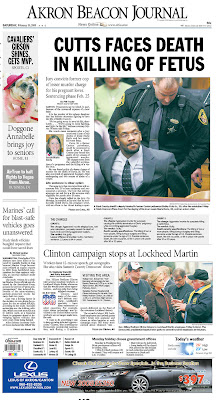 utts Jr, in the murder of his girlfriend Jessie Davis and her unborn child. Here is Phil Trexler’s lead:
CANTON: Prosecutors say he killed, in part, because of the unwanted expense of a new baby.
It is the murder of his unborn daughter that has defense attorneys fighting to save the life of Bobby Cutts Jr.
''We're going to try to save his life, absolutely. . . . We're going to keep fighting, and fight for his life,'' defense attorney Myron Watson said Friday.
His words came moments after a jury convicted Cutts of the deaths of Jessie Marie Davis and her nearly full-term fetus.
Cutts, 30, a former Canton patrolman, could be sentenced to death after a Stark County jury found him guilty of two counts of aggravated murder. The charges stem from the unlawful termination of a pregnancy and the killing of a viable fetus.
He was found guilty of a lesser charge of murder for the death of Davis, 26. He was also convicted of aggravated burglary, child endangering and two counts of abuse of a corpse.
Life sentence is other option
The same jury that convicted him will reconvene Feb. 25 to hear testimony and recommend a sentence. The best that defense attorneys can ask for is a life sentence with eligibility for parole after 25 years.
Click on the headline to read the full story
 utts Jr, in the murder of his girlfriend Jessie Davis and her unborn child. Here is Phil Trexler’s lead:
CANTON: Prosecutors say he killed, in part, because of the unwanted expense of a new baby.
It is the murder of his unborn daughter that has defense attorneys fighting to save the life of Bobby Cutts Jr.
''We're going to try to save his life, absolutely. . . . We're going to keep fighting, and fight for his life,'' defense attorney Myron Watson said Friday.
His words came moments after a jury convicted Cutts of the deaths of Jessie Marie Davis and her nearly full-term fetus.
Cutts, 30, a former Canton patrolman, could be sentenced to death after a Stark County jury found him guilty of two counts of aggravated murder. The charges stem from the unlawful termination of a pregnancy and the killing of a viable fetus.
He was found guilty of a lesser charge of murder for the death of Davis, 26. He was also convicted of aggravated burglary, child endangering and two counts of abuse of a corpse.
Life sentence is other option
The same jury that convicted him will reconvene Feb. 25 to hear testimony and recommend a sentence. The best that defense attorneys can ask for is a life sentence with eligibility for parole after 25 years.
Click on the headline to read the full story
Friday, February 15, 2008
Bruce Sherman killed KR, quits newspapers
Because of the great interest of our viewers, this story by Mark Fitgerald in Editor & Publisher is being posted in full and verbatim
Man Who Forced Knight Ridder Sale
Says Goodbye to Newspapers
By Mark Fitzgerald
Bruce Sherman, whose Private Capital Management (PCM) investment firm nearly single-handedly forced the sale of Knight Ridder -- ushering in the era of Wa ll Street antipathy toward newspaper stocks -- formally bid the sector goodbye in a series of regulatory filings Thursday.
In documents filed with the Securities and Exchange Commission (SEC), PCM said it no longer owned any stock in The New York Times Co., Lee Enterprises or Belo, and that it was effectively done as an investor in The McClatchy Co.
Sherman had signaled months ago that he was through with newspaper investing for now, and Thursday's filings amounted to a final housecleaning.
In September of 2005, for instance, PCM owned a gigantic 37.61% of McClatchy common stock. Thursday, the firm reported that it directly owned no shares at all, and was simply managing on behalf of an investor a tiny portfolio of 9,164 shares.
In that same period, PCM owned a 15.07% stake in the Times Co., an 18.96% stake in Lee, and a 22.31% stake in Belo. It also had substantial positions in Gannett and a small amount of Tribune Co. stock.
PCM was once both an angel and an irritant to publicly traded newspaper companies, buying up their stock -- but also agitating certain chains when he thought their stock performance was lagging.
Knight Ridder was his most famous target. In a November 2005 letter to Knight Ridder's board, Sherman demanded that what was then the nation's second-largest newspaper publisher "aggressively pursue the competitive sale of the company." Nine months later, Knight Ridder had been sold to McClatchy, which then sold off a dozen of the dailies to other companies.
It could be said that PCM stirred the hive of institutional investors and shareholders impatient with the plunging stocks of newspaper companies. Since Knight Ridder's forced sale, the ownership of Tribune and Dow Jones changed hands, the New York Times and Media General have come under attack from restive shareholders, and Belo and E.W. Scripps effectively distanced themselves from the newspaper business with spin-offs.
You can click on the headline to see the article in Editor & Publisher or write:
Mark Fitzgerald (mfitzgerald@editorandpublisher.com) is E&P's editor-at-large.
Man Who Forced Knight Ridder Sale
Says Goodbye to Newspapers
By Mark Fitzgerald
Bruce Sherman, whose Private Capital Management (PCM) investment firm nearly single-handedly forced the sale of Knight Ridder -- ushering in the era of Wa
 ll Street antipathy toward newspaper stocks -- formally bid the sector goodbye in a series of regulatory filings Thursday.
In documents filed with the Securities and Exchange Commission (SEC), PCM said it no longer owned any stock in The New York Times Co., Lee Enterprises or Belo, and that it was effectively done as an investor in The McClatchy Co.
Sherman had signaled months ago that he was through with newspaper investing for now, and Thursday's filings amounted to a final housecleaning.
Still, it was remarkable to see all those 0.0% ownerships of class in filing after filing because PCM not long ago had serious stakes in the nation's biggest publishers.
In September of 2005, for instance, PCM owned a gigantic 37.61% of McClatchy common stock. Thursday, the firm reported that it directly owned no shares at all, and was simply managing on behalf of an investor a tiny portfolio of 9,164 shares.
In that same period, PCM owned a 15.07% stake in the Times Co., an 18.96% stake in Lee, and a 22.31% stake in Belo. It also had substantial positions in Gannett and a small amount of Tribune Co. stock.
PCM was once both an angel and an irritant to publicly traded newspaper companies, buying up their stock -- but also agitating certain chains when he thought their stock performance was lagging.
Knight Ridder was his most famous target. In a November 2005 letter to Knight Ridder's board, Sherman demanded that what was then the nation's second-largest newspaper publisher "aggressively pursue the competitive sale of the company." Nine months later, Knight Ridder had been sold to McClatchy, which then sold off a dozen of the dailies to other companies.
It could be said that PCM stirred the hive of institutional investors and shareholders impatient with the plunging stocks of newspaper companies. Since Knight Ridder's forced sale, the ownership of Tribune and Dow Jones changed hands, the New York Times and Media General have come under attack from restive shareholders, and Belo and E.W. Scripps effectively distanced themselves from the newspaper business with spin-offs.
You can click on the headline to see the article in Editor & Publisher or write:
Mark Fitzgerald (mfitzgerald@editorandpublisher.com) is E&P's editor-at-large.
LA Times gets new top editor
The Los Angeles Times has named Russ Stanton, the paper's current innovation editor, its new top editor. H e replaces Jim O'Shea, who was forced out for resisting another in a series of staff cuts. Shea left in January after just 14 months on the job.
Mr. Stanton, who has been running The Times’s Web site, will take charge of an deeply unsettled newsroom that in less than three years has lost three chief editors, all of whom publicly protested the shrinking of the news staff.
Many editors and reporters resented the treatment of Mr. O’Shea — not to mention his predecessors — and for years the newsroom has been at odds with the paper’s publisher, David D. Hiller, and its corporate owner, the Tribune Company.
Mr. Hiller also named Jack D. Klunder, who has been in charge of the newspaper’s circulation department, to the new post of president of the newspaper, overseeing all the business operations. And he announced that David P. Murphy, who has headed the newspaper’s lagging advertising sales department, would be leaving.
Click on the headline to read a New York Times story or check Editor & Publisher for a story by Joe Strupp.
 e replaces Jim O'Shea, who was forced out for resisting another in a series of staff cuts. Shea left in January after just 14 months on the job.
Mr. Stanton, who has been running The Times’s Web site, will take charge of an deeply unsettled newsroom that in less than three years has lost three chief editors, all of whom publicly protested the shrinking of the news staff.
Many editors and reporters resented the treatment of Mr. O’Shea — not to mention his predecessors — and for years the newsroom has been at odds with the paper’s publisher, David D. Hiller, and its corporate owner, the Tribune Company.
Mr. Hiller also named Jack D. Klunder, who has been in charge of the newspaper’s circulation department, to the new post of president of the newspaper, overseeing all the business operations. And he announced that David P. Murphy, who has headed the newspaper’s lagging advertising sales department, would be leaving.
Click on the headline to read a New York Times story or check Editor & Publisher for a story by Joe Strupp.
NY Times to eliminate 100 newsroom jobs
The New York Times will bow to growing financial strain and eliminate about 100 newsroom jobs this year, the executive editor said Thursday.
The cuts will be achieved “by not filling jobs that go vacant, by offering buyouts, and if necessary by layoffs,” the executive editor, Bill Keller, said. The more people who accept buyouts, he said, “the smaller the prospect of layoffs, but we should brace ourselves for the likelihood that there will be some layoffs.”
He said, “We intend to move quickly, to get any cuts past us so that we do not spend a year bleeding slowly.”
The Times has 1,332 newsroom employees, the largest number in its history; no other American newspaper has more than about 900. There were scattered buyouts and job eliminations in the newsroom in recent years, but the overall number continued to rise, largely from the growth of its Internet operations.
The New York Times Company has made significant cuts in the newsrooms of some of its other properties, including The Boston Globe, as well as in nonnews operations. Executives say the overall headcount is 3.8 percent lower than it was a year ago. But with the industry’s economic picture worsening, the company is under increased pressure from shareholders — notably two hedge funds that recently bought almost 10 percent of the common stock — to do something significant to improve its bottom line.
The Times Company stock, which topped $52 in mid-2002, sank below $15 in January. The interest of the hedge funds has generated a slight rebound. Shares closed at $18.84 Thursday, partly in response to news of the probable layoffs.
Click on the headline to read the full story in the New York Times.
The cuts will be achieved “by not filling jobs that go vacant, by offering buyouts, and if necessary by layoffs,” the executive editor, Bill Keller, said. The more people who accept buyouts, he said, “the smaller the prospect of layoffs, but we should brace ourselves for the likelihood that there will be some layoffs.”
He said, “We intend to move quickly, to get any cuts past us so that we do not spend a year bleeding slowly.”
The Times has 1,332 newsroom employees, the largest number in its history; no other American newspaper has more than about 900. There were scattered buyouts and job eliminations in the newsroom in recent years, but the overall number continued to rise, largely from the growth of its Internet operations.
The New York Times Company has made significant cuts in the newsrooms of some of its other properties, including The Boston Globe, as well as in nonnews operations. Executives say the overall headcount is 3.8 percent lower than it was a year ago. But with the industry’s economic picture worsening, the company is under increased pressure from shareholders — notably two hedge funds that recently bought almost 10 percent of the common stock — to do something significant to improve its bottom line.
The Times Company stock, which topped $52 in mid-2002, sank below $15 in January. The interest of the hedge funds has generated a slight rebound. Shares closed at $18.84 Thursday, partly in response to news of the probable layoffs.
Click on the headline to read the full story in the New York Times.
Thursday, February 14, 2008
LA Times to cut 40 to 50 newsroom jobs, others
The Tribune Co., struggling with declining revenue, Wednesday said it would cut staff by 400 to 500 people companywide, or around 2% of the Chicago-based media company's workforce. At the Los Angeles Times, 100 to 150 jobs will be eliminated, 40 to 50 in the newsroom, through a combination of attrition, voluntary buyouts and, if necessary, layoffs, Publisher David D. Hiller said’
Tribune Chief Executive Sam Zell announced the news this morning in one of his frequent "Talk to Sam" e-mails to all employees. The job cuts are focused on the corporate staff and the company's nine newspapers, including, besides The Times, the Chicago Tribune, Newsday in New York, the Orlando Sentinel, the Baltimore Sun and the Hartford Courant.
The decision was reached during meetings Monday and Tuesday among senior executives at Tribune's Chicago headquarters, said Hiller’
For the moment, Tribune's broadcast division, consisting of KTLA-TV Channel 5 and nearly two dozen other stations around the country, will be spared. Fox TV veteran Ed Wilson, hired just last week to run the broadcast operation, will be given time to evaluate his business and make his own personnel decisions later, according to a Tribune executive familiar with the situation.
The job eliminations will come swiftly. Hiller said all the people affected would be out of the company by the end of March.
As in previous buyouts and layoffs at the L.A. Times, most departing employees will receive two weeks' pay per year of service, but this time there are two new elements. First, Hiller said that any buyouts next year would involve far smaller severance packages -- probably one week's pay per year of service. "Anyone who's been thinking about taking advantage of such a program might want to think seriously about this one," he said. Second, the cash to finance the buyouts will come from the overfunded portion of Tribune employees' cash-balance pension plan. Hiller said that Tribune officials have determined that the defined-benefit plan has about $300 million more than it needs to meet future obligations to retirees.
Click on the headlin to read the full story by Thomas S. Mulligan in the Los Angeles Times
Tribune Chief Executive Sam Zell announced the news this morning in one of his frequent "Talk to Sam" e-mails to all employees. The job cuts are focused on the corporate staff and the company's nine newspapers, including, besides The Times, the Chicago Tribune, Newsday in New York, the Orlando Sentinel, the Baltimore Sun and the Hartford Courant.
The decision was reached during meetings Monday and Tuesday among senior executives at Tribune's Chicago headquarters, said Hiller’
For the moment, Tribune's broadcast division, consisting of KTLA-TV Channel 5 and nearly two dozen other stations around the country, will be spared. Fox TV veteran Ed Wilson, hired just last week to run the broadcast operation, will be given time to evaluate his business and make his own personnel decisions later, according to a Tribune executive familiar with the situation.
The job eliminations will come swiftly. Hiller said all the people affected would be out of the company by the end of March.
As in previous buyouts and layoffs at the L.A. Times, most departing employees will receive two weeks' pay per year of service, but this time there are two new elements. First, Hiller said that any buyouts next year would involve far smaller severance packages -- probably one week's pay per year of service. "Anyone who's been thinking about taking advantage of such a program might want to think seriously about this one," he said. Second, the cash to finance the buyouts will come from the overfunded portion of Tribune employees' cash-balance pension plan. Hiller said that Tribune officials have determined that the defined-benefit plan has about $300 million more than it needs to meet future obligations to retirees.
Click on the headlin to read the full story by Thomas S. Mulligan in the Los Angeles Times
Here's the roundtable for BJ Retirees Lunch
 Bob Pell, Norma & Ed Hanzel, Al Hunsicker, Gene McClellan, Tim Hayes & Tom Moore
 Bob Pell and daughter Cathy Sandstead and Norma and Ed Hanzel
The top photo shows all who braved the weather to attend the monthly BJ Retirees lunch at Papa Joe's in the Valley on Wednesday. All except Bob Pell's daughter, Cathy Sandstead of Gulf Breeze, Florida, who took the photo. Cathy, who was visiting home, is shown with her father in another photo. She does a nice job as a photograper. Tom Moore took the other two photos.
Wednesday, February 13, 2008
Tim Smith is home from heart surgery
Since our report that Tim Smith would undergo heart surgery at Akron City Hospital on Ash Wednesday, we have received a number of inquiries from viewers asking how he is doing.
He is doing remarkably much better than this blogger did ater a tiny quadruple bypass in 1992.
Ah, the wonders of modern medicine.
Here's an emai report from the Kent State professor that proves my point:
He is doing remarkably much better than this blogger did ater a tiny quadruple bypass in 1992.
Ah, the wonders of modern medicine.
Here's an emai report from the Kent State professor that proves my point:
I am home at last, home at last. Tired, sore, in need of rehab, but alive and well and as cranky as ever following a six-way bypass. I’m looking into getting into the Guinness Book.
PD makes top 10 list for design
The Cleveland Plain Dealer is among the top 10 award winners in the Syracuse University / Society for News Design competition announced today The winners (12 winners named because of ties) are, in order, the Los Angeles Times; The New York Times; National Post; Zaman (Turkey); St. Petersburg (Fla.) Times; The Boston Globe; The Plain Dealer, Cleveland; Hartford Courant; Chicago Tribune; Dallas Morning News; San Jose Mercury News; San Francisco Chronicle.
The judging groups awarded eight Gold medals — details were previously listed on this blog — three to the L.A. Times, one each to The Plain Dealer (Cleveland), San Francisco Chronicle, The New York Times, The New York Times Magazine, and The Guardian. Of those, none of them were agreed upon by the entire judging panel as the Best of Show, and since that award must be unanimous, there is no Best of Show this year.
The judging groups awarded eight Gold medals — details were previously listed on this blog — three to the L.A. Times, one each to The Plain Dealer (Cleveland), San Francisco Chronicle, The New York Times, The New York Times Magazine, and The Guardian. Of those, none of them were agreed upon by the entire judging panel as the Best of Show, and since that award must be unanimous, there is no Best of Show this year.
Tuesday, February 12, 2008
BJ put on a big ad clinic at Mayflower Hotel in 1970
 How part of Mayflower ballroom looked during BJ ad clinic
A story in the March, 1970 issue of Tower Topics reported on a big clinic for advertisers held at the old Mayflower Hotel on S. Main Street which now houses senior citizens. It was headlined
Clinic A “Success’
A BJ-sponsored "Ads That Sell" Clinic was held at the Mayflower all day March 2, with over 175 advertisers turning out for what ad director Ed Latimer described as "an unqualified success."
The clinic was put on by two members of the New York-based Bureau of Advertising - - vice president, Bill Saleh and retail sales manager, Steve Van Osten.
The purpose, according to Latimer, was "to help our advertiser make his ads more effective and profitable."
The Bureau of Advertising experts held a working clinic and created ads on the spot, at the same time explaining what makes them effective.
This was the 2nd such clinic, and Latimer hopes to make an annual affair, with different variations.
"It was welcomed with great enthusiasm from our advertisers," he said. "Both large and small, classified and display."
In addition to two working clinics, a film was presented on advertising procedures used by European department stores, and .a luncheon that mled up the ballroom.
McCain grabs most --if not best--attention
Republican frontrunner John McCain generated the most media attention of any candidate in a week that saw the highest level of coverage yet for the 2008 presidential campaign. For the week of February 4-10, which included the Super Tuesday parade of primaries, McCain was a significant or dominant newsmaker in 42% of all campaign stories. As leading newsmaker for the second straight week, he narrowly edged Democrats Hillary Clinton (41%) and Barack Obama (40%), according to a Project for Excellence in Journalism study of campaign coverage.
While McCain, Clinton and Obama received the most press attention; none of them generated the media narrative they really wanted. McCain’s Super Tuesday results made him the presumptive nominee, but many stories focused on his struggles with unhappy Republican conservatives. And with the results of the Democratic primaries reinforcing a story of stalemate, the media began examining the possibility of a deadlock that goes all the way to the nominating convention.
Thanks to Super Tuesday, fully 55% of the newshole last week was filled by election stories—the highest level of election coverage since PEJ started measuring it in January 2007.
The Project for Excellence in Journalism’s “Campaign Coverage Index”—which will appear weekly until the party nominees are selected—also finds that:
- Mike Huckabee’s surprising Super Tuesday showing proved once again that journalists had written him off too soon. He was a significant or dominant newsmaker in 19% of last week’s stories, nearly a ten-fold increase from a mere 2% the week before.
- Mitt Romney (28%) earned his highest level of coverage to date; but some of it was dedicated to the post-mortem of a campaign that ended after Super Tuesday.
- Just two weeks after Bill Clinton figured in 18% of the campaign coverage and generated criticism of his prominent role, his disappearing act continued. For the week of Feb. 4-10, he registered as a significant or dominant newsmaker in only 2% of stories.
- Republicans (41%) slightly edged out Democrats (38%) in the race for overall party coverage.
Monday, February 11, 2008
Star Tribune to lay off 58 workers
By H.J. Cummins, Minneapolis Star Tribune
The Star Tribune this morning announced the layoff of 58 employees, about 3 percent of the newspaper’s workforce, and an indefinite wage freeze for all its nonunion employees, about 600 in total.
Publisher Chris Harte cited continuing revenue declines, the efficiencies of new technology and outsourcing in a morning memo to employees.
Three-fourths of the eliminated jobs are in the circulation department, which got the news at 9 a.m. meetings. The exiting employees will receive the same severance given to about 140 employees who took voluntary buyouts last May, which is two weeks’ pay for every year’s employment and six months of health coverage.
At that time, the company hoped those cuts would be enough to stabilize finances, Harte wrote in the memo.
“Since then, the national and state economies have further weakened, and our key classified markets — real estate, automotive and employment — have fared even worse than the overall economy,” he wrote.
In a previous communication to employees, Harte said total revenue declined almost $75 million over the past two years. The circulation cuts come as the outsourcing of home delivery to independent agents was completed, newspaper spokesman Ben Taylor said in an interview.
There are also reductions in single-copy delivery, as truck drivers assume duties previously performed by other staff, Taylor said.
The other quarter of eliminated jobs are scattered throughout the company, although Taylor stressed no journalism or ad sales jobs are being cut with this announcement.
However, last week two unions — the Guild and the Graphic Communications International Union — that represent seven photo technicians in the newsroom were told the company plans to replace most of them with technology. Taylor said he expects 1½ or 2½ positions to remain.
The wage freeze follows a freeze on the company’s 12 senior executives, including Harte, in January, the memo said.
Layoffs continue to be a part of the contracting newspaper industry, analyst John Morton said Monday.
The Star Tribune this morning announced the layoff of 58 employees, about 3 percent of the newspaper’s workforce, and an indefinite wage freeze for all its nonunion employees, about 600 in total.
Publisher Chris Harte cited continuing revenue declines, the efficiencies of new technology and outsourcing in a morning memo to employees.
Three-fourths of the eliminated jobs are in the circulation department, which got the news at 9 a.m. meetings. The exiting employees will receive the same severance given to about 140 employees who took voluntary buyouts last May, which is two weeks’ pay for every year’s employment and six months of health coverage.
At that time, the company hoped those cuts would be enough to stabilize finances, Harte wrote in the memo.
“Since then, the national and state economies have further weakened, and our key classified markets — real estate, automotive and employment — have fared even worse than the overall economy,” he wrote.
In a previous communication to employees, Harte said total revenue declined almost $75 million over the past two years. The circulation cuts come as the outsourcing of home delivery to independent agents was completed, newspaper spokesman Ben Taylor said in an interview.
There are also reductions in single-copy delivery, as truck drivers assume duties previously performed by other staff, Taylor said.
The other quarter of eliminated jobs are scattered throughout the company, although Taylor stressed no journalism or ad sales jobs are being cut with this announcement.
However, last week two unions — the Guild and the Graphic Communications International Union — that represent seven photo technicians in the newsroom were told the company plans to replace most of them with technology. Taylor said he expects 1½ or 2½ positions to remain.
The wage freeze follows a freeze on the company’s 12 senior executives, including Harte, in January, the memo said.
Layoffs continue to be a part of the contracting newspaper industry, analyst John Morton said Monday.
We were 15th in U.S. in lines of news run
Here's a story that is difficult to believe, but there are many retireesl who should remember it. It's from the March, 1970 Tower Topics:
By MICKEY PORTER
The Beacon Journal has moved from 16th to 15th place among American newspapers in the amount of lines of news run last year, according to Media Records, the chief measuring organization in the industry.
This was the second straight . advance for the BJ, having moved from 28th place in 1967.
A total of 25,610,557 lines of news was presented to Akron area readers, up from 24,498,929 lines in 1968.
That's more news than was provided by any paper in Philadelphia, Baltimore, Houston, St. Louis, Milwaukee, San Francisco, Dallas, New Orleans, Columbus, Pittsburgh, Atlanta, Minneapolis, Cincinnati, and on and on.
The 14 papers ahead of us, topped by the Los Angeles Times' 31.5 million lines, are, in order, the LA Times, New York Times, Miami Herald, Washington Post, Denver Post, San Francisco Examiner & Chronicle, Sacramento Bee, Cleveland Plain Dealer, San Jose Mercury, Boston Herald Traveler, Boston Globe, Chicago Tribune, Ft. Lauderdale News and Detroit News.
Following us, and rounding out the top 25, are the Newark News, Santa Ana Register, Oakland Tribune, Hartford Courant, San Diego Union, Columbus Dispatch, Seattle Times, Washington Star, Milwaukee Journal and St.Petersburg Times.
Total Advertising lineage also was up, although we slipped from 25th to 26th place.
Last year the BJ ran 48,708,172 lines of advertising as compared to 46,960,192 lines in 1968.
However, we were the 12th ranked evening-Sunday combination, with only the Milwaukee Journal, Houston Chronicle, Minneapolis Star, Atlanta Journal, Ft. Lauderdale News, Columbus Dispatch, Dallas TimesHerald, Denver Post, St. Louis Post-Dispatch, Santa Ana Register and Detroit News.
The Knight group placed four of its papers in the top 50 in advertising. The Miami Herald was third, behind the Los Angeles Times and New York Times; the Philadelphia Inquirer was 15th; the BJ 26th, and the Charlotte Observer 46th.
By MICKEY PORTER
The Beacon Journal has moved from 16th to 15th place among American newspapers in the amount of lines of news run last year, according to Media Records, the chief measuring organization in the industry.
This was the second straight . advance for the BJ, having moved from 28th place in 1967.
A total of 25,610,557 lines of news was presented to Akron area readers, up from 24,498,929 lines in 1968.
That's more news than was provided by any paper in Philadelphia, Baltimore, Houston, St. Louis, Milwaukee, San Francisco, Dallas, New Orleans, Columbus, Pittsburgh, Atlanta, Minneapolis, Cincinnati, and on and on.
The 14 papers ahead of us, topped by the Los Angeles Times' 31.5 million lines, are, in order, the LA Times, New York Times, Miami Herald, Washington Post, Denver Post, San Francisco Examiner & Chronicle, Sacramento Bee, Cleveland Plain Dealer, San Jose Mercury, Boston Herald Traveler, Boston Globe, Chicago Tribune, Ft. Lauderdale News and Detroit News.
Following us, and rounding out the top 25, are the Newark News, Santa Ana Register, Oakland Tribune, Hartford Courant, San Diego Union, Columbus Dispatch, Seattle Times, Washington Star, Milwaukee Journal and St.Petersburg Times.
Total Advertising lineage also was up, although we slipped from 25th to 26th place.
Last year the BJ ran 48,708,172 lines of advertising as compared to 46,960,192 lines in 1968.
However, we were the 12th ranked evening-Sunday combination, with only the Milwaukee Journal, Houston Chronicle, Minneapolis Star, Atlanta Journal, Ft. Lauderdale News, Columbus Dispatch, Dallas TimesHerald, Denver Post, St. Louis Post-Dispatch, Santa Ana Register and Detroit News.
The Knight group placed four of its papers in the top 50 in advertising. The Miami Herald was third, behind the Los Angeles Times and New York Times; the Philadelphia Inquirer was 15th; the BJ 26th, and the Charlotte Observer 46th.
BJ retirees to meet for lunch Wednesday
Don't forget the Beacon Journal Retirees Lunch at 1 p.m. Wednesday at Papa Joe's Restaurant in the Valley (Portage Trail at Akron-Peninsula Road).
The lunch has been attracting a dozen--or even less--each month. Current employees of the Beacon Journal are always welcome at the luncheons which are the second Wednesday of every month at Papa Joe's Restaurant. There is no agenda--no business--just lots of chatter by old fogies about how much better things used to be.
Hope to see you there.
The lunch has been attracting a dozen--or even less--each month. Current employees of the Beacon Journal are always welcome at the luncheons which are the second Wednesday of every month at Papa Joe's Restaurant. There is no agenda--no business--just lots of chatter by old fogies about how much better things used to be.
Hope to see you there.
Saturday, February 09, 2008
McClatchy sees profit; charge set
The McClatchy Co. reported slightly better-than-expected profit for the fourth quarter Wednesday but said revenue continues to get hammered by competition from the Internet and a "recessionary" economy that's particularly rough on its California and Florida newspapers.
Sacramento-based McClatchy, the nation's third-largest newspaper publisher, said the first quarter of 2008 looks rocky but that the rest of the year might improve.
McClatchy also said it will take a non-cash charge against earnings to reflect the steep decline in its stock price. McClatchy said the charge, which will be detailed later this month, won't cost any money but will depress on paper the reported fourth-quarter profits.
McClatchy, which publishes The Bee, said it earned $30.1 million in the quarter, or 37 cents a share. That compared with a $279.3 million loss a year earlier, the result of a loss the company took on the sale of its Minneapolis newspaper.
Earnings from continuing operations totaled $33.2 million, or 40 cents a share, compared with a year-ago profit of $76.9 million, or 94 cents a share. The latest earnings were reduced by 9 cents a share because of additional tax expenses. If those costs are factored out, McClatchy earned 49 cents a share, or a penny higher than the consensus estimate of Wall Street analysts, according to Thomson Financial.
The quarter's revenue fell nearly 15 percent, to $573.4 million. The decline was exaggerated because the fourth quarter of 2006 had an extra week. Eliminating that extra week, revenue fell 9.1 percent.
Gary Pruitt, McClatchy's chairman and chief executive, said the company will continue to reduce expenses where it can, but the short-term advertising outlook remains troubling.
Friday, February 08, 2008
Capital Times to cut daily paper
Copy editors are most vulnerable as the Madison, Wis. paper focuses on the web and cuts its print frequency to twice a week. "This is probably an intelligent response to a difficult situation," says newspaper analyst John Morton.
After 90 years, Madison's afternoon newspaper will stop daily printing and shift its focus to its Web site and a more widely distributed free weekly print edition, its top executives said Thursday.
The move at The Capital Times will end the era of two daily newspapers in Madison, one of the last U.S. cities of its size to retain what had once been a common practice. The broadsheet newspaper will stop publishing six days a week on April 26 and start publishing a tabloid-format news weekly on Wednesdays, starting April 30.
The afternoon newspaper, which began publishing on Dec. 13, 1917, faced, like other papers, declining circulation that had dipped to 17,000 from a height of about 47,000 four decades ago.
The move drew national interest Thursday because the newspaper is one of the most prominent, so far, to make the move to publishing primarily online.
Click on the headline to read a story in the Wisconsin State Journal
After 90 years, Madison's afternoon newspaper will stop daily printing and shift its focus to its Web site and a more widely distributed free weekly print edition, its top executives said Thursday.
The move at The Capital Times will end the era of two daily newspapers in Madison, one of the last U.S. cities of its size to retain what had once been a common practice. The broadsheet newspaper will stop publishing six days a week on April 26 and start publishing a tabloid-format news weekly on Wednesdays, starting April 30.
The afternoon newspaper, which began publishing on Dec. 13, 1917, faced, like other papers, declining circulation that had dipped to 17,000 from a height of about 47,000 four decades ago.
The move drew national interest Thursday because the newspaper is one of the most prominent, so far, to make the move to publishing primarily online.
Click on the headline to read a story in the Wisconsin State Journal
Uncle of Bob Tigelman dies
[Mr. Tigelman is the uncle of Robert Tigelman, BJ information technology, whose wife Colleen is a former BJ department editor. He also was the uncle of secretary Mary Ann Taray.]
Norbert Frank Tigelman
Norbert Frank Tigelman, 85, died suddenly Wednesday, February 6, 2008.
He was born in Akron. He retired from the U.S. Postal Service. Frank was a member of St. John the Baptist Catholic Church, VFW Post 3383, Sons of Herman, Mogadore Moose, and the Fraternal Order of Eagles 555 and a veteran of the Army serving during World War II. He was also the leader of the Frank Tigelman Band which he truly loved. A loving and generous person, he will be dearly missed by family and friends.
Mr. Tigelman was preceded in death by wife, Roseann and brother, Joseph. He is survived by sons and daughters-in-law, Frank and Sandy, Richard and Beth, Steven and Susie, Michael and Becky; daughter-in-law, Johanna Tigelman; brother, Adam; grandchildren, Sherry "Peapot", Scott (Danielle), David, Steven (Josalyn); step-grandchildren, Larry Yoder, Jeremy Yoder and Norman Schafrath; great-grandchildren, Kara and Caydene; nephew, Robert (Colleen) Tigelman; niece, Mary Ann (Joseph) Taray; and many friends.
The family will receive friends TODAY, 5 to 8 p.m. at the Anthony Funeral Home Kucko-Anthony-Kertesz Chapel, 1990 S. Main St. (PLEASE NOTE NEW ADDRESS). Funeral services will be held Saturday, 9:30 a.m. at the funeral home, followed by Mass of Christian Burial at 10 a.m. at St. John the Baptist Catholic Church. Interment at Holy Cross Cemetery, where military services will be held.
(Anthony Funeral Home Kucko-Anthony-Kertesz Chapel, 330-724-1281, www.kakfh.com)
[Beacon Journal, Akron, OH,Friday, February 8, 2008, page B7, col. 5]
Norbert Frank Tigelman
Norbert Frank Tigelman, 85, died suddenly Wednesday, February 6, 2008.
He was born in Akron. He retired from the U.S. Postal Service. Frank was a member of St. John the Baptist Catholic Church, VFW Post 3383, Sons of Herman, Mogadore Moose, and the Fraternal Order of Eagles 555 and a veteran of the Army serving during World War II. He was also the leader of the Frank Tigelman Band which he truly loved. A loving and generous person, he
 will be dearly missed by family and friends.
 Mr. Tigelman was preceded in death by wife, Roseann and brother, Joseph. He is survived by sons and daughters-in-law, Frank and Sandy, Richard and Beth, Steven and Susie, Michael and Becky; daughter-in-law, Johanna Tigelman; brother, Adam; grandchildren, Sherry "Peapot", Scott (Danielle), David, Steven (Josalyn); step-grandchildren, Larry Yoder, Jeremy Yoder and Norman Schafrath; great-grandchildren, Kara and Caydene; nephew, Robert (Colleen) Tigelman; niece, Mary Ann (Joseph) Taray; and many friends.
The family will receive friends TODAY, 5 to 8 p.m. at the Anthony Funeral Home Kucko-Anthony-Kertesz Chapel, 1990 S. Main St. (PLEASE NOTE NEW ADDRESS). Funeral services will be held Saturday, 9:30 a.m. at the funeral home, followed by Mass of Christian Burial at 10 a.m. at St. John the Baptist Catholic Church. Interment at Holy Cross Cemetery, where military services will be held.
(Anthony Funeral Home Kucko-Anthony-Kertesz Chapel, 330-724-1281, www.kakfh.com)
[Beacon Journal, Akron, OH,Friday, February 8, 2008, page B7, col. 5]
Covering the Cutts trial online at the Rep.
The following post appeared on the Bowling Green alumni blog of former BJ staffer Beth Hertz. Scott Brown, a BGSU alum, is really sold on web news which he practices at the Canton Repository. The Rep is doing a good job of handling news online. There has been more online than in print about the Cutts trial for murder of Jessie Davis
You Can't Print THAT
From Scott Brown, Class of '98
"Kill that bitch."
I bet that grabbed you. Now, imagine that as a headline in 120-point type at the top of Page A-1.
That didn't happen at The Repository this week, although it was briefly discussed. At issue was a witness in the murder trial of Canton police officer Bobby L. Cutts Jr., who is accused of killing his 9-months-pregnant girlfriend and the unborn child. A friend had just testified that a month before the woman disappeared, Cutts said he wanted to "kill that bitch and throw her body in the woods."
Nine days after the girlfriend, Jessie Davis, was reported missing, her remains were found in an Akron park.The quote was the most sensational part yet of a trial that has us devoting two reporters, one photographer and one editor full-time, not to mention a third reporter who has had to testify because he interviewed Cutts during the search.
The headline didn't fly for all the obvious reasons (it ran as a pullquote on A-1). But we did use the headline in a story that was posted at our Web site, cantonrep.com, about 15 minutes after it happened.
Why use it on the Web and not in print? For a lot of reasons, not the least of them being our hope to be more edgy with our Web site than we are with the print edition.Viewers seemed to like it. Our numbers shot up. About an hour after the story was posted, we added audio of the "kill that bitch" quote. The next hour was the busiest in the history of our Web site.
Oh, and the actual A-1 head? "Threats revealed." Old gray lady, that print edition.
Thursday, February 07, 2008
More industry gloom and doom
Want to hear more gloom and doom about the newspaper industry?
"What is happening now [in the newspaper industry] is something new, something more serious than anyone has experienced in generations," writes Richard Perez-Pena in a New York Times article. Bits from his story:
+ Some of the largest papers -- including The San Francisco Chronicle, The Boston Globe and The Los Angeles Times -- have lost 30 to 40 percent of their circulation in just a few years.
+ Most papers have cut their newsrooms and simply done less reporting, especially overseas.
+ It could take five to 10 years for the industry's finances to stabilize and that many of the papers that survive will be smaller and will practice less ambitious journalism.
Click on the headline for the full story.
"What is happening now [in the newspaper industry] is something new, something more serious than anyone has experienced in generations," writes Richard Perez-Pena in a New York Times article. Bits from his story:
+ Some of the largest papers -- including The San Francisco Chronicle, The Boston Globe and The Los Angeles Times -- have lost 30 to 40 percent of their circulation in just a few years.
+ Most papers have cut their newsrooms and simply done less reporting, especially overseas.
+ It could take five to 10 years for the industry's finances to stabilize and that many of the papers that survive will be smaller and will practice less ambitious journalism.
Click on the headline for the full story.
McClatchy faces 50% writeoff of KRI deal
The McClatchy Co. could be on track to write off half of the $4.4 billion it paid for the Knight Ridder newspapers it proudly acquired in the summer of 2006.
That's the word from Alan D. Mutter, writer of a blog called Reflections of a Newsosaur. He writes:
The dramatic failure of the transaction – which took place in the early days of a catastrophic downturn for the newspaper industry that few foresaw at the time – is evident in McClatchy’s announcement that it will have to take the second writedown in three months to reduce the value of the KRI assets it carries on its books.
McClatchy said it would take a still-to-be-determined accounting adjustment to reflect the $602.2 million drop in the price of its shares in the fourth quarter of last year. Since the end of 2007, its shares have plunged another $173.4 million to close today at $10.54 per share. Thus, the market capitalization of the company has fallen in five months by $775.6 million from $1.6 billion on Sept. 30 – a plunge of 51%.
Lest we forget, McClatchy’s shares were worth some $2.5 billion on the day before it announced its plans to buy KRI in March, 2006 – vs. $865.9 million today.
The deep drop in the value of the McClatchy’s shares in the fourth quarter of 2007 is forcing the publisher to take the second extraordinary charge against its earnings in as many quarters. In the third quarter of 2007, McClatchy wrote off nearly $1.4 billion of the value of the goodwill of the assets it acquired when it purchased Knight Ridder.
If you add the $1.4 billion writeoff in the third quarter to the $775 6 million drop in the stock to date, the sum is equal to a shade under $2.2 billion, or almost exactly half of what McClatchy paid to buy Knight Ridder in the summer of 2006.
Click on the headline to read the full article by Nutter.
Note: Alan D. Mutter began his career as a newspaper columnist and editor in Chicago, starting at the Chicago Daily News and later rising to City Editor of the Chicago Sun-Times. In 1984, he became the No. 2 editor of the San Francisco Chronicle. He left the newspaper business in 1988 to join InterMedia Partners, a start-up company that within five years became one of the 12 largest cable-TV companies in the U.S.
That's the word from Alan D. Mutter, writer of a blog called Reflections of a Newsosaur. He writes:
The dramatic failure of the transaction – which took place in the early days of a catastrophic downturn for the newspaper industry that few foresaw at the time – is evident in McClatchy’s announcement that it will have to take the second writedown in three months to reduce the value of the KRI assets it carries on its books.
McClatchy said it would take a still-to-be-determined accounting adjustment to reflect the $602.2 million drop in the price of its shares in the fourth quarter of last year. Since the end of 2007, its shares have plunged another $173.4 million to close today at $10.54 per share. Thus, the market capitalization of the company has fallen in five months by $775.6 million from $1.6 billion on Sept. 30 – a plunge of 51%.
Lest we forget, McClatchy’s shares were worth some $2.5 billion on the day before it announced its plans to buy KRI in March, 2006 – vs. $865.9 million today.
The deep drop in the value of the McClatchy’s shares in the fourth quarter of 2007 is forcing the publisher to take the second extraordinary charge against its earnings in as many quarters. In the third quarter of 2007, McClatchy wrote off nearly $1.4 billion of the value of the goodwill of the assets it acquired when it purchased Knight Ridder.
If you add the $1.4 billion writeoff in the third quarter to the $775 6 million drop in the stock to date, the sum is equal to a shade under $2.2 billion, or almost exactly half of what McClatchy paid to buy Knight Ridder in the summer of 2006.
Click on the headline to read the full article by Nutter.
Note: Alan D. Mutter began his career as a newspaper columnist and editor in Chicago, starting at the Chicago Daily News and later rising to City Editor of the Chicago Sun-Times. In 1984, he became the No. 2 editor of the San Francisco Chronicle. He left the newspaper business in 1988 to join InterMedia Partners, a start-up company that within five years became one of the 12 largest cable-TV companies in the U.S.
Newseum to open April 11
The founders of the Newseum, a state-of-the-art museum about the news industry, will announce today that they plan to open April 11, about six months later than originally announced.
"That is when everything will be done," said Charles L. Overby, the chief executive officer of the museum. By everything Overby means the seven levels with 250,000 square feet of exhibition space, including 15 theaters, 14 galleries, two broadcast studios, 100 original videos and more than 130 interactive stations. Intertwined in that is a history of the media, from the start of printing to the digital age.
At 6 a.m. today, the Newseum planned to post the April 11 date on the 40-by-22 foot electronic screen just inside its glass facade. Passersby at Pennsylvania Avenue and Sixth Street NW, where the building takes up half a block, will be able to see the announcement. The museum will also debut its front-pages display today with headlines and covers from 80 U.S. and international papers. It, too, will be visible from the sidewalk.
Click on the headline to read a Washington Post story. Or click on photo to go to Newseum website which has a photo.
"That is when everything will be done," said Charles L. Overby, the chief executive officer of the museum. By everything Overby means the seven levels with 250,000 square feet of exhibition space, including 15 theaters, 14 galleries, two broadcast studios, 100 original videos and more than 130 interactive stations. Intertwined in that is a history of the media, from the start of printing to the digital age.
At 6 a.m. today, the Newseum planned to post the April 11 date on the 40-by-22 foot electronic screen just inside its glass facade. Passersby at Pennsylvania Avenue and Sixth Street NW, where the building takes up half a block, will be able to see the announcement. The museum will also debut its front-pages display today with headlines and covers from 80 U.S. and international papers. It, too, will be visible from the sidewalk.
Click on the headline to read a Washington Post story. Or click on photo to go to Newseum website which has a photo.
Kathryn Pell Brown, sister of Bob Pell, dies
Kathryn Pell Brown "Kitty"
Kathryn Pell Brown "Kitty", age 80, lately of Hephzibah, Ga., passed away Tuesday morning, Feb 5, 2008.
[She is the sister of retired Beacon Journal printer Bob Pell]
Kitty was born in Parkersburg, W. Va., and reared in Clay, W. Va. She and her husband, Bill, lived in the Akron, Ohio, area for over 50 years. In a teaching career of over 30 years that began at her high school alma mater, Clay County High, and spanned from coast to coast, Kitty taught business classes and retired from Barberton High. She loved teaching and loved her students and developed life-long and endearing friendships with other educators. She remained passionate about education all of her life. She had a ready laugh and loved people, always willing to give, help, and encourage.
In addition to her husband, she leaves a son, Will; daughter-in-law, Beth; grandson, Joshua; her brother, Bob; and sister, Trana, as well as many nieces and nephews whom she loved dearly.
[Beacon Journal, Akron, OH, Thursday, February 7, 2008, page B5, coll. 2]
Kathryn Pell Brown "Kitty", age 80, lately of Hephzibah, Ga., passed away Tuesday morning, Feb 5, 2008.
[She is the sister of retired Beacon Journal printer Bob Pell]
Kitty was born in Parkersburg, W. Va., and reared in Clay, W. Va. She and her husband, Bill, lived in the Akron, Ohio, area for over 50 years. In a teaching career of over 30 years that began at her high school alma mater, Clay County High, and spanned from coast to coast, Kitty taught business classes and retired from Barberton High. She loved teaching and loved her students and developed life-long and endearing friendships with other educators. She remained passionate about education all of her life. She had a ready laugh and loved people, always willing to give, help, and encourage.
In addition to her husband, she leaves a son, Will; daughter-in-law, Beth; grandson, Joshua; her brother, Bob; and sister, Trana, as well as many nieces and nephews whom she loved dearly.
[Beacon Journal, Akron, OH, Thursday, February 7, 2008, page B5, coll. 2]
A sampling of reporter top minimums
Here is our selection of top minimum salaries of Newspaper Guild reporters by rank as published in the January 25, 2008 issue of the Guild Reporter. We are listing those which might be of interest to our viewers. The number at the end is the numbers of years after which the top minimum is paid. Click on the headline for the complete interest.
1. Consumer Reports 1804.10 4
2. New York Times 1675.28 2
3.. Reuters 1587.93 6
12. Minneapolis Star-Tribune 1344.00 6
16. Philadelphia Inquirer and Daily News 1307.37 4
18. San Jose Mercury News 1273.14 6
22. Wall Street Journal (US) 1258.00 6
23. St. Paul Pioneer Press 1240.15 6
33. Associated Press 1170.00 6
35, Cleveland Plain Dealer 1167.21 5
41, Akron Beacon Journal 1111.60 5
45. Pittsburgh Post-Gazette 1100.83 5
48. Honolulu Star-Bulletin 1077.00 9
49. Toledo Blade 1069.73 4
74.Catholic Universe Bulletin Publishing 928.37 6
79. Detroit Free Press 910.34 5
80. Canton Repository 909.55 5
110. Newsweek 741.00 2
111. Youngstown Vindicator 738.55 5
136. Massillon Independent 585.28 4
137. United Press International 576.92 4
1. Consumer Reports 1804.10 4
2. New York Times 1675.28 2
3.. Reuters 1587.93 6
12. Minneapolis Star-Tribune 1344.00 6
16. Philadelphia Inquirer and Daily News 1307.37 4
18. San Jose Mercury News 1273.14 6
22. Wall Street Journal (US) 1258.00 6
23. St. Paul Pioneer Press 1240.15 6
33. Associated Press 1170.00 6
35, Cleveland Plain Dealer 1167.21 5
41, Akron Beacon Journal 1111.60 5
45. Pittsburgh Post-Gazette 1100.83 5
48. Honolulu Star-Bulletin 1077.00 9
49. Toledo Blade 1069.73 4
74.Catholic Universe Bulletin Publishing 928.37 6
79. Detroit Free Press 910.34 5
80. Canton Repository 909.55 5
110. Newsweek 741.00 2
111. Youngstown Vindicator 738.55 5
136. Massillon Independent 585.28 4
137. United Press International 576.92 4
Wednesday, February 06, 2008
Ad environment not improving, says Pruitt
McClatchy Co expects a lower quarterly profit from continuing operations and will record a charge to net earnings to account for a declining share price.
McClatchy said it was still carrying out impairment testing of goodwill and other long-lived assets and will issue final results when it files with U.S. securities regulators.
The company reported preliminary fourth-quarter profit from continuing operations of $33.2 million, or 40 cents per share. from $76.9 million, or 94 cents per share. It cited a deeper downturn in print advertising, particularly in California and Florida.
"The advertising environment in 2008 does not appear to be improving," McClatchy Chief Executive Gary Pruitt said in a statement. "In fact, in January we've seen headwinds from a worsening national economy."
Click on the headline to read the report from Reuters.
Pruitt said he expected advertising would be down in the low-double-digit percentage range in the first quarter.
Net profit before the expected charge was $30.1 million, or 37 cents, on a preliminary basis. Revenue fell to $573.4 million from $673.6 million.
Advertising revenue fell 9.3 percent from a year earlier, and circulation revenue dropped 7.8 percent.
McClatchy publishes the Miami Herald, Sacramento Bee and more than two dozen other newspapers.
McClatchy's shares traded 19 cents higher at $10.54 on the New York Stock Exchange.
McClatchy said it was still carrying out impairment testing of goodwill and other long-lived assets and will issue final results when it files with U.S. securities regulators.
The company reported preliminary fourth-quarter profit from continuing operations of $33.2 million, or 40 cents per share. from $76.9 million, or 94 cents per share. It cited a deeper downturn in print advertising, particularly in California and Florida.
"The advertising environment in 2008 does not appear to be improving," McClatchy Chief Executive Gary Pruitt said in a statement. "In fact, in January we've seen headwinds from a worsening national economy."
Click on the headline to read the report from Reuters.
Pruitt said he expected advertising would be down in the low-double-digit percentage range in the first quarter.
Net profit before the expected charge was $30.1 million, or 37 cents, on a preliminary basis. Revenue fell to $573.4 million from $673.6 million.
Advertising revenue fell 9.3 percent from a year earlier, and circulation revenue dropped 7.8 percent.
McClatchy publishes the Miami Herald, Sacramento Bee and more than two dozen other newspapers.
McClatchy's shares traded 19 cents higher at $10.54 on the New York Stock Exchange.
Tuesday, February 05, 2008
Tully named publisher at San Jose
MediaNews today named Mac Tully, former publisher of the Kansas City Star, as publisher of the Mercury News.
Tully replaces Jeff Kiel, who in a message to the staff today said that his experience leading the Mercury News was "one I will remember fondly."
Tully also becomes Group Vice President of the Bay Area News Group, a newly created position overseeing the company's Bay Area newspapers, including the Mercury News, Contra Costa Times, Oakland Tribune, Marin Independent Journal and the Santa Cruz Sentinel. Tully becomes the third publisher at the Mercury News since it was purchased by MediaNews in 2006.
"Mac's wealth of experience in managing both groups of newspapers as well as in publishing large market newspapers will prove invaluable to our company," said William Dean Singleton, CEO of MediaNews. "This is a great newspaper and a great market," Tully said today. "The Bay Area has great opportunities." He said the newspaper industry will adapt to a changing market, but will survive. "We'll be leaner and meaner, but we'll be there," he said.
A veteran of Knight Ridder, the former parent company of the Mercury News, Tully rose through that company to become a corporate vice president before taking over as the Star's publisher in 2005.
He began his career at the Star in 1978 as a retail account executive. He later became vice president of advertising at the Fort Worth Star-Telegram and was publisher of an edition of that paper, the Arlington,
Click on the headline to read Pete Carey’s article in the Mercury News. See January 28 post on Tully
Tully replaces Jeff Kiel, who in a message to the staff today said that his experience leading the Mercury News was "one I will remember fondly."
Tully also becomes Group Vice President of the Bay Area News Group, a newly created position overseeing the company's Bay Area newspapers, including the Mercury News, Contra Costa Times, Oakland Tribune, Marin Independent Journal and the Santa Cruz Sentinel. Tully becomes the third publisher at the Mercury News since it was purchased by MediaNews in 2006.
"Mac's wealth of experience in managing both groups of newspapers as well as in publishing large market newspapers will prove invaluable to our company," said William Dean Singleton, CEO of MediaNews. "This is a great newspaper and a great market," Tully said today. "The Bay Area has great opportunities." He said the newspaper industry will adapt to a changing market, but will survive. "We'll be leaner and meaner, but we'll be there," he said.
A veteran of Knight Ridder, the former parent company of the Mercury News, Tully rose through that company to become a corporate vice president before taking over as the Star's publisher in 2005.
He began his career at the Star in 1978 as a retail account executive. He later became vice president of advertising at the Fort Worth Star-Telegram and was publisher of an edition of that paper, the Arlington,
Click on the headline to read Pete Carey’s article in the Mercury News. See January 28 post on Tully
Monday, February 04, 2008
BJ publisher is happy buying newspapers
 ` (Honolulu Star Bulletin)
If printed papers are dying, publisher David Black of Victoria acts like the happy guy at the funeral.
That’s the deck for a story headlined:
A Canadian is shaking up the Northwest newspaper business
Here’s a sample from an article by O. Casey Corr, writing for a blog called Crosscut which covers Northwest journalism:
So consider a 61-year-old Canadian named David Black, who's heard tales about the slow, painful death of newspapers, the supposed dinosaurs in the age of the Internet, and he's the happy guy at the funeral. From his office in Victoria, B.C., Black has been steadily putting money into newspapers and their future. Others may be closing or selling; he's buying or starting papers. And you wonder, what does he see that most everybody is missing?
If Black is wrong, someone ought to tell him he can't afford his 77-foot yacht and one of British Columbia's most celebrated homes. Today, Black may own more newspapers and related publications than anyone else in Washington. How many in Puget Sound? "About 60," he says, noting that he just launched two weeklies serving Issaquah and Sammamish. His papers reach 1 million households in Western Washington. Altogether, his Black Press Ltd. publishes 175 dailies, community papers, Little Nickel shoppers, and Web sites. It's a Victoria-based communications empire that includes holdings in British Columbia, Hawaii, and Ohio, and 4,000 employees, all run out of a 1910 mansion called Riffington, which Black once referred to as a "nice, old pile of rock."
Black started small. He grew up in Williams Lake, a small British Columbia lumber town that calls itself the hub of the Cariboo region. After earning an M.B.A. and working as a business analyst for the Toronto Star, he returned home and spent a reported $6,000 to buy the local weekly from his father. He was 29. Three years later, he bought a second weekly, then a printing company, then other papers served by the printing company. For a long time, Black bought little publications that never got a panelist on Meet the Press, but earned nice profits. Later, he took bigger gulps, buying the Akron Beacon Journal and the Honolulu Star-Bulletin.
In a conversation over the phone, I told Black that he reminded me of another entrepreneur who started very small in Winlock, Wash., and who built an empire by buying mom-and-pop cable TV companies before moving to paging and mobile phones — Craig McCaw. But Black would have no such comparison. "Craig McCaw's brilliant. We're not brilliant here." Okay, but I see a few things in common: a talented leader who professes to do something simple over and over, a fierce competitor who may be underestimated by rivals, and a hugely successful businessman who doesn't want a high profile. Another similarity is a contrarian's viewpoint.
The Star-Bulletin is an example, a paper so hopeless that for a long time it couldn't find a buyer. Nobody wanted a money loser that competed with Gannett, the biggest player in the business. Except for Black, who paid $10,000 for the Star-Bulletin when it had no press, no building, no carriers, no advertising department, not even a telephone. The paper had 80 reporters and editors whose work was published in an expiring joint operating agreement with the Honolulu Advertiser, Gannett's paper. Black also bought a press and a paper called MidWeek that was distributed free to every home on the island of Oahu.
To gain insight into Black's business strategy, stop on that phrase "every home." While most newspaper publishers traditionally try to sell their product, and get by largely on advertising revenue and a household "penetration" of 20 percent or so of a given market, Black often gives away his papers and makes it up from advertisers who are attracted to his saturation of households. "Our game is to get on every doorstep," he says. In some markets, his paper reaches 90 percent of households. Black didn't invent the idea of market saturation, but he does it well, thanks to a focus on keeping costs low and spreading press costs across multiple publications. He employed the same tactic on the Eastside of Lake Washington when he bought King County Journal Newspapers. He closed the company's money-losing daily and expanded the roster of community newspapers to 12 distinct publications, nine of them free.
Black is a feared competitor. He'll cut ad rates to grab business. He often reduces staff or lowers pay. No doubt, his critics would call him a bottom feeder, an enemy of quality journalism. And yet, as a personality, he is widely described as softspoken and pleasant. Nothing about his manner suggests the guts and drive that built so much, so fast, in an industry where many now feel something close to despair. When he speaks, it's plain vanilla. What's his secret? "We look at opportunities we can afford. When prices come down, that makes it a little bit easier."
See what I mean? A guy who sees what others miss doesn't have to talk fancy. "Business is an interesting game," he says. Especially if you're winning.
Blog Note: Casey Corr writes the Mudville blog for Crosscut. He is a Seattle-based writer who previously worked for The Seattle Times and Seattle Post-Intelligencer. He is author of books about Seattle broadcast pioneer Dorothy Bullitt and wireless communications visionary Craig McCaw. He worked as a senior advisor to Seattle Mayor Greg Nickels, ran for Seattle City Council in 2005, and recently taught business journalism at the University of Washington. You can e-mail him at casey.corr@crosscut.com.
Click on the headline to see the blog piece.
Tim Smith to urdergo open heart surgery
Kent State University professor Timothy D. Smith, a former managing editor of the Beacon Journal, will undergo open heart surgery at Akron City Hospital on Ash Wednesday, Feburary 6.
Subscribe to:
Posts (Atom)
