Here's a note from retired BJ chief photographer Bill Hunter:
An explanation about the Maidenburg note. It was response to a picture I sent him from one of the Bud Morris picnics, a group shot of the then current and former BJ newsroom types. I had tried to get him to attend. I think he really wanted to, but he was a proud man, and didn't want people seeing him with the canes.
[See the Jan 10 post about the BJ retirees luncheon which shows a newsroom photo from the mid-1950s and has a link to Maidenburg's memo.]
We had two of those picnics, first one in [August] 1982. It was so successful that everybody clamored for another one, which we did in 1985. It was for people that had worked there prior to 1970. It was Polly, Murphey, Bud and I that put them together, both held at Bud's place on Medina Line Rd. People came from all over the country. I think pictures from both picnics have already appeared in the blog, along with idents supplied by Craig Wilson. It was one of those
pictures that I had sent to Ben.
[There are posts about the 1983 picnic in the February 2005 archives on Feb 12, 18 and 23]
The group shot in the newsroom was taken sometime in the early to mid 1950's. That's Carl Dangel on the extreme left in the photo, I think he started at the BJ about the same time that I did, which would make it sometime shortly after 1952. There are 43 people in the picture, and I am able to name all but about four or five. Some have their faces blocked, have no idea who they are. A couple are very recognizable, but I have no idea who they are.
I'm hoping Art Cullison may be able to help. That one young girl in the white blouse is somebody I dated for a while, but I'm damned if I can remember her name. It may come to me. I'll try to get together with Art, and maybe between the two of us, we'll be able to get idents for everybody.
I've got phone directories from lates 60's through 93-94, when I retired. I also have copies of Guild contracts from the same times. Sort of interesting to see what pay scales were.
Saturday, January 13, 2007


Friday, January 12, 2007
Reporters often do not ask tough questions, says Giles
Reporters often are not asking the tough questions, Bob Giles notes in a piece on the CBS News Public Eye website.
Each week the web site ask guests to weigh in with their thoughts about CBS News and the media at large. Giles, curator of the Nieman Foundation at Harvard University and former Beacon Journal managing editor and executive editor, this week discusses the harm in U.S. news outlets' lack of tough questions
Here is an excerpt of what Giles said:
“Not long ago, I was with a group of journalists looking at videotapes of a BBC reporter interviewing British Prime Minister Tony Blair. The reporter was clearly well informed and was aggressively pressing Blair when the prime minister’s answers seemed less than forthcoming. It was wonderful journalistic combat and highly informative for the audience.”
“These interviews represent a striking contrast with the U.S. television, where there is an absence of spirited inquiry. Public officials are treated with courtesy, which is appropriate, but on balance are accorded far too many opportunities to respond to reporters’ queries without challenge. When the reporter fails to probe more deeply, he or she becomes simply an electronic stenographer providing the elected official or official spokesperson a video platform for getting out the message.
“A recent CBS News Investigative Unit story offers a case in point. The story reported that billions of dollars spent on the Iraq War may have been lost to contractor waste, fraud and abuse. The story was based on a whistleblower lawsuit that had been obtained by CBS News.
“In the segment, forthright and detailed comments were made during on-camera interviews with Sen. Patrick Leahy, D-Vt., who as new chair of the Senate Judiciary Committee plans to investigate how taxpayer dollars have been spent in Iraq, and Alan Grayson, a lawyer who has filed dozens of lawsuits against contractors.
“The government response came from a “senior Justice Department official” who was not shown on camera and who was quoted indirectly as saying that it takes two to three years to investigate civil fraud cases and, even then, only about one in five meet the standards necessary for prosecution.
“If the reporter challenged the official to respond more directly to the allegations, this was not shared with viewers, leaving the impression that the Justice Department got away with a non-response.”
Click on the headline to read the full story.
Each week the web site ask guests to weigh in with their thoughts about CBS News and the media at large.
 Giles, curator of the Nieman Foundation at Harvard University and former Beacon Journal managing editor and executive editor, this week discusses the harm in U.S. news outlets' lack of tough questions
Here is an excerpt of what Giles said:
“Not long ago, I was with a group of journalists looking at videotapes of a BBC reporter interviewing British Prime Minister Tony Blair. The reporter was clearly well informed and was aggressively pressing Blair when the prime minister’s answers seemed less than forthcoming. It was wonderful journalistic combat and highly informative for the audience.”
“These interviews represent a striking contrast with the U.S. television, where there is an absence of spirited inquiry. Public officials are treated with courtesy, which is appropriate, but on balance are accorded far too many opportunities to respond to reporters’ queries without challenge. When the reporter fails to probe more deeply, he or she becomes simply an electronic stenographer providing the elected official or official spokesperson a video platform for getting out the message.
“A recent CBS News Investigative Unit story offers a case in point. The story reported that billions of dollars spent on the Iraq War may have been lost to contractor waste, fraud and abuse. The story was based on a whistleblower lawsuit that had been obtained by CBS News.
“In the segment, forthright and detailed comments were made during on-camera interviews with Sen. Patrick Leahy, D-Vt., who as new chair of the Senate Judiciary Committee plans to investigate how taxpayer dollars have been spent in Iraq, and Alan Grayson, a lawyer who has filed dozens of lawsuits against contractors.
“The government response came from a “senior Justice Department official” who was not shown on camera and who was quoted indirectly as saying that it takes two to three years to investigate civil fraud cases and, even then, only about one in five meet the standards necessary for prosecution.
“If the reporter challenged the official to respond more directly to the allegations, this was not shared with viewers, leaving the impression that the Justice Department got away with a non-response.”
Click on the headline to read the full story.
Boston Globe, T&G look to cut 125 spots
The New England Media Group said yesterday it will offer voluntary buyout packages to employees at The Boston Globe and the Worcester Telegram & Gazette, as it aims to cut 125 jobs from the two papers, including 19 in the Globe newsroom and editorial pages.
Fifty-five jobs to be cut in the buyout will be outsourced to outside contractors, said Alfred S. Larkin Jr., the Globe spokesman, primarily in finance operations.
"Our expectation is we will be able to accomplish our goal without resorting to layoffs," Larkin said.
The buyouts, the second round since the fall of 2005, come as the newspapers struggle with falling circulation and advertising revenue against the backdrop of similar declines in the industry. The New York Times Co., parent of the Globe and Telegram & Gazette, recently said that ad revenue at its New England group fell 11 percent in November from the same period a year ago.
In the six months ended in September, the most recent figures available, the Globe's average daily circulation declined 7 percent to about 386,000 from 414,000 a year earlier. The Telegram & Gazette reported an 11 percent decline in average daily circulation in that period, to 89,000.
Dan Totten, president of the Boston Newspaper Guild, denounced the outsourcing initiative as "corporate greed at its worst."
Read the full story by Robert Gavin of the Globe Staff
Read memos from publisher Steve Ainsley and editor Martin Baron
Fifty-five jobs to be cut in the buyout will be outsourced to outside contractors, said Alfred S. Larkin Jr., the Globe spokesman, primarily in finance operations.
"Our expectation is we will be able to accomplish our goal without resorting to layoffs," Larkin said.
The buyouts, the second round since the fall of 2005, come as the newspapers struggle with falling circulation and advertising revenue against the backdrop of similar declines in the industry. The New York Times Co., parent of the Globe and Telegram & Gazette, recently said that ad revenue at its New England group fell 11 percent in November from the same period a year ago.
In the six months ended in September, the most recent figures available, the Globe's average daily circulation declined 7 percent to about 386,000 from 414,000 a year earlier. The Telegram & Gazette reported an 11 percent decline in average daily circulation in that period, to 89,000.
Dan Totten, president of the Boston Newspaper Guild, denounced the outsourcing initiative as "corporate greed at its worst."
Read the full story by Robert Gavin of the Globe Staff
Read memos from publisher Steve Ainsley and editor Martin Baron
Thursday, January 11, 2007
John Olesky and Paula visit China

John Olesky and Paula didn’t take an easy access up to the Great Wall during their visit to China December 25 to January 2. Their tour guide, Tiger, took them to the Juyong Pass. That meant they had to climb 396 rock steps, which vary from two inches to about two feet, with each step a different height than the one below and above. To read about their trip, click on the headline above for John’s account on the BJ Retirees web site. There you will find a link to an album of photos. There are other photos of the Great Wall, which is 4,400 miles long, plus Tiananmen Square and a photo of John and Buddha.
Community News is mostly crime
Today was the third day running for the new Community News page on page B3 in the Beacon Journal. Ads appeared for the first time. There were 34 column inches of advertising or about 27 per cent of the 129 column inches on the page. All ads were from advertisters in Akron, Cuyahoga Falls and Barberton– none from outlying areas.
There was only one news item concerning local government. Three graphs were given to a plan by Medina school board to seek a sales tax increase. Another brief was about a Summit County elections board employee who will remain off the job while the sheriff investigates allegations he rented a truck without authorization. The other 10 items were about crimes.
There was only one news item concerning local government. Three graphs were given to a plan by Medina school board to seek a sales tax increase. Another brief was about a Summit County elections board employee who will remain off the job while the sheriff investigates allegations he rented a truck without authorization. The other 10 items were about crimes.
Wednesday, January 10, 2007
14 attend retirees lunch
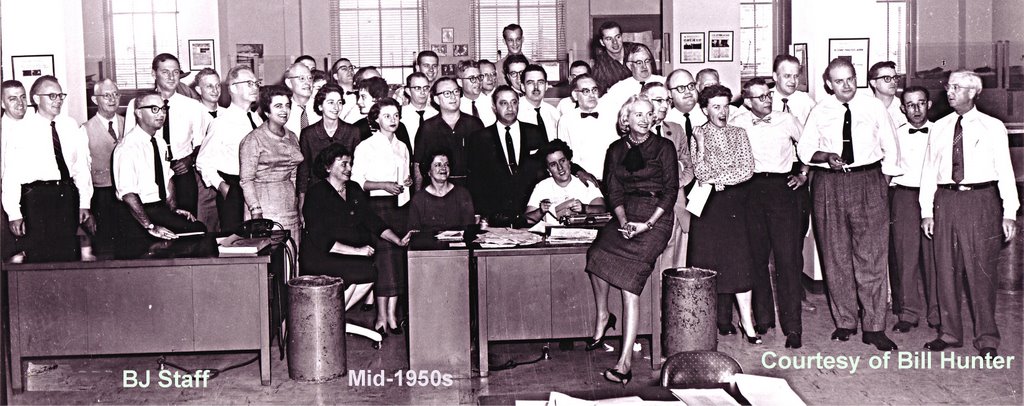
There were 14 at Papa Joe's for the BJ retirees' lunch today. Attending were Tom Moore, Cal Deshong, Bill Canterbury, Art Cullison, William Byrd, Gene McClellan, Watson Blanton and wife Rosetta, Ed Hanzel and wife Norma, Al Hunsicker, Bill Hunter, Carl Nelson and John Olesky.
Former chief photographer Bill Hunter brought old photos of newsroom personnel and Guild contracts, to show the paltry pay scales by today's standards.
The photo here is of the newsroom staff in the mid-1950s.
[Click on the photo to enlarge it for a better view]
Hunter also showed a memo he received from the late publisher Ben Maidenburg to thank him for sending him a photo of the staff at a 1980s picnic at the farm of Bud Morris. The photos sparked memories and laughter and maybe a bit of wistfulness.
The photo here is of the newsroom staff in the mid-1950s.
[Click on the photo to enlarge it for a better view]
Hunter also showed a memo he received from the late publisher Ben Maidenburg to thank him for sending him a photo of the staff at a 1980s picnic at the farm of Bud Morris. The photos sparked memories and laughter and maybe a bit of wistfulness.
Olesky, former TV editor, talked about his trip to China. Click here to read the Maidenburg memo. Click on the headline above to see an album of lunch photos.
TV personality Alice Weston dies
Alice Weston, who started her broadcasting career with a cooking show on WEWS Channel 5 in 1948 and retired as a seniors reporter for WKYC Channel 3 in 1996, died Tuesday at her home in Sheffield Lake.
She was 95.
When she became the host of one of Cleveland's first television shows for women, her name was not Weston - and she hated to cook.
"When I was beginning, there was only one path available for women in the new medium, and that was the discussion of food," Weston told an interviewer in 1978. "We've come a long way since 1948."
WEWS executives didn't like the real name of their newly hired happy homemaker - Alice Schowalter. They chose "Weston" as her small-screen surname, because its ring was similar to that of the station's call letters.
In 1968, she went to WUAB Channel 43 to help the fledgling station get started. What was supposed to be a six-month project stretched into a 26-year career. She served as public service director for Lorain and hosted such shows as "Lorain Conversation." In the 1970s and '80s, she co-hosted "43 A.M." with Linn Sheldon, better known to many as the elfin star of the children's show "Barnaby."
In 1994, Weston left WUAB for WKYC Channel 3 to do news segments about senior citizens.
She was born Alice Boter in Holland, Mich., to parents who emigrated from the Netherlands. Her father, a merchant, helped found the city's famous Tulip Time Festival.
Alice Weston 1911-2007
Survivors: Daughters, Susan Ruffing of Sheffield Lake and Sara Walters of Chicago; two grandchildren; and four great-grandchildren.
Services: Pending.
Arrangements: Bauer-Laubenthal Funeral Home, Elyria.
Click on the headline to read the full story by Alice Baranick in the Plain Dealer.
Tuesday, January 09, 2007
The BJ's local news surge
As advertised, the Beacon Journal kicked off its big local news surge today with a full page of briefs on page B3 and a large (4 col. X 12 inch) Paul Tople photo layout on a crew installing a sound wall on I-77 at 13th Avenue in Canton.
Three of the 18 briefs were from Akron, two from Barberton and one each from Bath, Boston Heights, Canal Fulton, Cuyahoga Falls, green, Medina, Norton, Revere schools, Stow, Wadsworth and Norteast Ohio (about a bald eagle count). There were none from Portage or Wayne counties-- the other two counties in the old five-county area once served by seven different editions.
Biggest brief was Revere Schools electing board officers--9 graphs. Credit at the bottom of briefs was given to five correspodents: Gina Mace 3, George W.. Davis and Jody Miller 2 each and Kimberly Sirk and Beau Dusz, 1 each.
Monday, January 08, 2007
Prescription math
[Posted for John Olesky]
Prescription math
I applied the math from my 2006 prescriptions to the 2007 changes decreed by the Canadian, even though the Guild contract for those who retired in 1996 and earlier and my retirement letter both say that I have the $2 co-pay and medical coverage for life.
As I understand the changes, and I'd be happy to recalculate if anyone, including management, finds an error in my figures, it would cost me up to $1,949.41 more a year in 2007 if I get the same monthly prescriptions that I did in 2006. I think I'm about average, since I'm in pretty good health.
Here's how I arrived at the up to $1,949.41 total of EXTRA prescription costs for 2007:
$643.41 in co-pays for the 5.4 months that it will take me to reach the $2,400 limit.
$1,450 for the donut hole, between $2,400 and $3,850, where the retiree pays everything on the prescriptions. Only what I pay is applied to go from $2,400 to $3,850, and I had NO generic prescriptions in 2006, so it's murky how much I would pay to get the same non-generic prescriptions.
$2,093.41 is the total amount that I can pay before I hit the $3,850 limit, if I ever do. As I understand it, and I'm open to correction, then the Canadian's plan would pay 100% of my prescription costs for the rest of the year, but the Canadian's plan seems to all but assure that no Guild retiree will hit the $3,850 limit.
$144.00 is the amount that I pay under the current plan, at $2 per prescription.
$1,949.41 is the difference between what I pay under the current plan and what I would pay under the Canadian's plan for the same prescriptions if I hit the $3,850 limit.
Prescription math
I applied the math from my 2006 prescriptions to the 2007 changes decreed by the Canadian, even though the Guild contract for those who retired in 1996 and earlier and my retirement letter both say that I have the $2 co-pay and medical coverage for life.
As I understand the changes, and I'd be happy to recalculate if anyone, including management, finds an error in my figures, it would cost me up to $1,949.41 more a year in 2007 if I get the same monthly prescriptions that I did in 2006. I think I'm about average, since I'm in pretty good health.
Here's how I arrived at the up to $1,949.41 total of EXTRA prescription costs for 2007:
$643.41 in co-pays for the 5.4 months that it will take me to reach the $2,400 limit.
$1,450 for the donut hole, between $2,400 and $3,850, where the retiree pays everything on the prescriptions. Only what I pay is applied to go from $2,400 to $3,850, and I had NO generic prescriptions in 2006, so it's murky how much I would pay to get the same non-generic prescriptions.
$2,093.41 is the total amount that I can pay before I hit the $3,850 limit, if I ever do. As I understand it, and I'm open to correction, then the Canadian's plan would pay 100% of my prescription costs for the rest of the year, but the Canadian's plan seems to all but assure that no Guild retiree will hit the $3,850 limit.
$144.00 is the amount that I pay under the current plan, at $2 per prescription.
$1,949.41 is the difference between what I pay under the current plan and what I would pay under the Canadian's plan for the same prescriptions if I hit the $3,850 limit.
Editorials moved back to A section
Editorial and op-ed pages were moved back to the last two pages of the A section today and the nameplate of the Local & Opinion section has changed to read simply 'Local."
Managing editor Mizell Stewart announced the changes in an A3 column on Sunday thusly:
"Starting Tuesday, the pages formerly occupied by the editorial and commentary pages will be devoted to local news, anchored by t ne Community News page on B3.
"The Community News page will provide a quick read on local news and events, with short items from communities throughout our area. It will be the place to turn to find out what happened at last night's council, school boatrd or township trustee meetings.
"In additon, you'll find a visual glimpse of daily life in the region as captured by our award winning photo staff."
Blogger Note: Can't wait.
Managing editor Mizell Stewart announced the changes in an A3 column on Sunday thusly:
"Starting Tuesday, the pages formerly occupied by the editorial and commentary pages will be devoted to local news, anchored by t ne Community News page on B3.
"The Community News page will provide a quick read on local news and events, with short items from communities throughout our area. It will be the place to turn to find out what happened at last night's council, school boatrd or township trustee meetings.
"In additon, you'll find a visual glimpse of daily life in the region as captured by our award winning photo staff."
Blogger Note: Can't wait.
Sunday, January 07, 2007
Blog headlines and photos in 2006
There were 424 items posted on the Beacon Journal retirees blog in 2006. We have pulled out 195 of them to make it easier for you to review the tumultuous year at the Beacon Journal.
Just click on the headline to go to the Blog Review of 2006
There you will find a link to the 195 headlines and also a link to an album of blog photos showing the top events of 2006 at the BJ
The review also lists the names of 22 who died during the year.
Because of the sale of Knight Ridder, subsequent sale of the Beacon Journal and the turmoil over layoffs, the visits to the blog increased from 8,883 at the beginning of the year to 32,245 on our December report. The average number of visits increased from 36 a day at the beginning of the year to 73 the week ending December 27. There were 129 the week ending November 8.
In the 29 months since the blog was established in July, 2004, there have been 824 articles posted or an average of more than 28 a month. The number probably will top 1,000 in the next couple of months.
A web site was opened September 18, 2006 to allow use of articles too long for the blog and for storage of information files such as our list of postal addresses of retirees. A Commentary section also was added.
Avista comments on Star Tribune
A report in the Wall Street Journal says few of the headline-grabbing buyouts have been as gutsy as the $530 million planned purchase by Avista Capital Partners of McClatchy Co.'s Minneapolis Star
The deal for the nation's 15th-largest newspaper by circulation comes amid a slump in the business. The Star Tribune has been the worst-performing paper in terms of revenue for McClatchy, which paid $1.2 billion for the paper in 1998. The Star Tribune's ad revenue dropped about 6% last year on a circulation decline of about 4%.
Avista mightn't be a household name, but its founders, Thompson Dean and Steven Webster, have been well known in the buyout community for more than a decade.
So what do they see with the Star Tribune deal that others in the buyout world missed? A very cheap price -- 6.5 times the paper's cash flow -- a respected brand and an industry that may be bottoming out and poised for a rebound.
"We got a premium paper in a healthy market, and we paid a very attractive price," says Dean. "There is meaningful franchise value for top-20 papers. The risk is that readership continues its steady decline."
"Newspapers are poised to stabilize their revenue base, and advertising rates are stabilizing," Dean says. "People will continue to read newspapers."
Dean wouldn't address whether Avista will slash costs or lay off employees. "Newspapers have to recognize that they are operating in a different environment, with different pressures, declining readership and advertising pressures," he says. "We have to get additional revenue growth and do things more efficiently, but that may not be about staff cuts."
While public investors penalize newspaper companies for their lack of growth, private-equity investors generally are more concerned with steady cash flows. And newspapers usually don't have steep capital expenditures that soak up cash.
So if the Star Tribune's circulation stops declining and Avista can generate some growth for the paper's Web site, the firm might avoid significant cost cutting.
"To generate an acceptable return, we only need modest growth because of [the paper's] impressive high free-cash flow," and the low purchase price that Avista paid, Mr. Dean says.
Although Avista hasn't made previous newspaper acquisitions, it placed Chris Harte, a former Knight Ridder executive whose family is among the owners of San Antonio-based direct-marketing firm and publisher Harte-Hanks Inc., as the chairman of Star Tribune's holding company.
Click on the headline to read the full Wall Street Journal story by Gregory Zuckerman.
Saturday, January 06, 2007
Wadsworth Banner to close after 142 years
The Sun News is closing three of its 25 newspapers on Jan. 25, including the Wadsworth Sun Banner that has been serving Wadsworth for 142 years
The Banner, the Sun Scoop Journal (in the Collinwood neighborhood of Cleveland) and The West Summit Sun (serving west central Summit County) are ``underperforming,'' said Sun News president and CEO John Urbancich.
``We're retrenching and shifting resources away from unprofitable areas to revenue-generating areas,'' Urbancich said, citing dwindling circulation and declining ad revenue in those communities.
`Sun News is ``likely'' to have The Plain Dealer in Cleveland print all of its editions starting in April, removing that work from American Color Graphics in Medina. Urbancich said the move will save money. (Sun News is a division of Advance Publications Inc., which also owns The Plain Dealer.)
The location of the Medina bureau will close when the lease ends in July. No decision has been made whether to move that staff to another office or find another place in or near Medina.
``I don't want anyone to think we're pulling out of Medina County, because we're not,'' Urbancich said, noting that two other local papers, the Brunswick Sun Times and The Medina Sun, will still publish.
Click on the headline to read the full story by Paula Schleis on the business front (page D1) of Saturday’s Beacon Journal. Schleis quotes BJ owner David Black as stating it would have no effect on the BJ.
Briefs on news media layoffs
Time may cut 150 jobs
Time Inc. may decide in the next two weeks to cut 150 jobs, and Time magazine could be particularly hard hit, the New York Post reported on Friday, citing sources. The cuts at Time Inc., a unit of Time Warner Inc. , could happen across the board, and include other top magazines such as People and Sports Illustrated, the Post reported. [Copyright Reuters]
Guild members may take the Strib's money and run
The abrupt sale of the Minneapolis Star Tribune to Avista Capital Partners the day after Christmas left many of the paper's employees wondering how soon they'd be shown the door. But a little-known clause in the paper's contract with union journalists suggests that its employees might have good reason to look for the door--possibly in droves.
Article VIII of the Star Tribune's contract with the Minnesota Newspaper Guild and Typograhical Union ensures all employees represented by the union the right to exercise a buyout should the paper be sold to an outside buyer. Within five days of a sale, employees must express their interest in the option; in return, they'll receive two weeks of pay for every year worked, with a 40-week maximum. The purchase by Avista is expected to be completed in "early 2007." While the Guild represents employees at the St. Paul Pioneer Press as well, the stipulation is specific to Star Tribune's Guild members.
The Star Tribune's management representative was unavailable for comment.
Click here to read the full story
Thursday, January 04, 2007
The Lonely Newspaper Reader
Charlie Buffum, BJ retiree in New York City who still reads newspapers, calls our attention to a column in the Times by David Carr who muses about the sale of the Minneapolis Star Tribune and about how his children now rush off to the digital world while he sits alone with four papers at the kitchen table.
You will want to click on the headline to read the full story, but if you are like Carr’s family and only need a quick fix, here are the salient graphs:
The paper, around in one version or another since 1867, may not have knocked down a lot of Pulitzers, but with its vigorous political reporting and thoughtful cultural coverage, it has served as a center for civic life in Minneapolis and beyond. The Star Tribune was not a great paper, but then my first car, a very used ’64 Ford Falcon, wasn’t great either. I still have a great deal of affection for both.
There are two ways to look at the sale: the second-biggest newspaper operator in the country, with its stock dropping in the wake of the Knight Ridder deal, dumped a paper with near 20 percent profit margins in what looked like a fire sale because big papers are doomed. Or, more brightly, a private equity firm saw an opportunity for a savvy investor who could operate the property without the quarter-to-quarter franticness that comes with making Wall Street happy.
It is a cliché of the media business that the assets go up and down the elevator every day. In Minneapolis, many of those assets are pals from my days of working as a reporter and editor at a weekly there, so I wondered: Who would be controlling their professional destinies, bottom feeders or benefactors?
Private equity owners are often viewed with suspicion, in part because they have limited investment horizons and tend to milk properties for cash flow, clean up the balance sheet and then flip the property to what is technically known as a “greater fool.” The sale of The Philadelphia Inquirer and Daily News by McClatchy to a local group of investors has resulted, after a sharp downturn this summer, in a great deal of strife and talks of significant layoffs.
I talked to OhSang Kwon, one of the partners in Avista Capital Partners. “We don’t want to rule out anything, but the idea that we bought this paper with a quick exit in mind or that we were going to cut our way to profitability is not correct,” he said. “I don’t have the hubris to say that we have the answers — we are new to the newspaper business — but the old way was not working. Maybe it is time for a different approach.”
As I sat at the kitchen table, I marveled at the low price of a newspaper that had once preoccupied the conversation around my dinner table. Then I looked at the four papers on the table and the empty chairs that surrounded them. Before my second cup of coffee, the rest of my household had already started the day in a way that had nothing to do with the paper artifacts in front of me. Maybe I was the greater fool.
Wednesday, January 03, 2007
Retirees seek answers on change in benefits

[The blog is not responsible for accuracy of any of this information. See the information below on numbers to contact for information.]
All but a few chairs in the JSK conference room at the Beacon Journal were filled Wednesday by retirees attending an information session on the change in benefits.
Retirees will no longer be covered by United Health Care, a PPO (preferred provide organization) provider of secondary coverage, which allowed unlimited prescriptions at $2 co-pay for many with Medicare as the primary insurer.
The 329 retirees are now being asked to enroll in an Aetna (private fee for service) program which will handle both the Medicare and prescription program.
The Beacon Journal will pay the monthly premium.
A representative from Aetna outlined the program and answered questions. Also on hand were Aaron Burr, head of BJ Human Resources Department; Karen Jones, benefits coordinator and legal counsel Karen Lefton.
An answer to one question, explained that in reaching the $2,400 initial coverage limit the total would be based on actual drug costs. From that point until reaching the $3,850 level (called the coverage gap or donut hole) the retiree’s out of pocket costs and not the costs of the drugs would be used. Generic drugs during that period would still cost only the $5 co-pay.
There are no generic ($5 co-pay) drugs for diabetes or Alzheimer’s medications.
In answer to questions, Lefton explained that different contracts with different labor unions in different years could mean a difference in some benefits. She noted that letters were provided to some employees in years past promising certain benefits. But those promises had to be part of the contract or a legally-binding side-letter agreement and not just a notice given to employees. She said retirees should consult their contract at the time they retired to see what benefits were stipulated. Copies of these contracts and any side letters will be provided to retirees who request them, she said.
You can call benefits coordinator Karen Jones at 330-996-3183 for some information. For detailed information on the Aetna program it is probably best to call Aetna at 1-800-307-4830 or for the hearing impaired 1-800-628-3323.
The Aetna web site is at www.aetnamedicare.com You can read or download the Aetna formulary (list of drugs) for 2007 which lists drugs by brand name and generic name and states whether they are in Tier 1 or $5 co-pay for generic., Tier 2 ($20 co-pay) for preferred brand or Tier 3 ($40 co-pay for non-preferred drugs.
If you order drugs by mail, the co-pay is doubled but you get a 90-day supply rather than 30 days.
Alice Gresock, widow of Don, dies
Alice G. Gresock, age 78, passed away January 1, 2007, in San Antonio, Texas.
She was born April 16, 1928, in San Antonio, to Paul and Julia Mahoney Gonzales.
She was preceded in death by her first husband, Francis J. Walsh of Dublin, Ireland and second husband, Donald W. Gresock of Akron, Ohio.
[Beacon Journal retiree Don Gresock died in San Antonio on December 5, 2004]
Alice is survived by children, Catherine Bartlow and husband Richard, Julie Walsh, Frank Walsh and wife, Regina, Stephen Walsh and wife, Hazel Briseno and Brian Walsh; 12 grandchildren; seven great-grandchildren; brother; Paul Gonzales and wife, Lou; brother-in-law, Richard Gresock and wife, Lorraine; sister-in-law, H. Patricia Brunner; and numerous nieces and nephews.
The family wishes to give special thanks to all the staff with Sisters Care, Morningside Manor and VITAS Hospice for their generous care over the years.
A Vigil Service will be held Thursday, January 4, 2007, 7 p.m. at Porter Loring North Chapel. A Mass will be held Friday, January 5, 2007, 10 a.m. at St. Matthew's Catholic Church. Interment will follow at San Fernando Cemetery #2. You are invited to sign the Guestbook at www.porterloring.com. Arrangements with PORTER LORING MORTUARY NORTH, 2102 NORTH LOOP 1604 EAST, SAN ANTONIO, TX 78232. (210) 495-8221
[The Beacon Journal,, Akron, OH, Wednesday, January 3, 2007 ]
68 in Inquirer newsroom to lose jobs
Philadelphia Media Holdings L.L.C. said yesterday that it would lay off 68 newsroom employees, or 17 percent of the editorial staff, in another round of cost cutting at The Inquirer.
PMH said the cutbacks would save about $6.8 million a year in salaries and benefits and would lead to more restructuring of beats and coverage areas as the slimmed-down news staff regroups to report the region's news.
The Inquirer newsroom will have 325 employees after the cutbacks. As the cuts approached, a handful of reporters and editors left. The Daily News will have 106 newsroom employees.
"It's a very difficult day for The Inquirer and for the individuals, and we're going to try and handle this with professionalism, dignity, thoughtfulness and care," Inquirer editor William K. Marimow said last night. He said the cutbacks were smaller than earlier plans, which called for more than 100 jobs to be eliminated.
PMH, a group of local businesspeople, led by public relations and advertising executive Brian Tierney, bought The Inquirer, Daily News, Philly.com and other publications for $562 million in June.
Tierney said recently that he intended to invest $20 million in marketing, plant modernizations, and a jazzed-up Web site.
Click on the headline to read the story by Inquirer staff writer Bob Fernandez.
Services set for David Bonar
Family and friends will remember David Troyer Bonar at a 1 p.m. Friday, Jan. 5, service inside the Rose Hill Burial Park Mausoleum, 3535 W. Market St., Fairlawn. The Rev. Thomas Heinlein of Westminster Presbyterian Church will officiate.
Mr. Bonar's interment at Rose Hill will be with his father and mother, Boyd and Lula (Troyer) Bonar, to whom he was born Oct. 13, 1925, in Akron, and where they were members of Westminster.

A 1943 graduate of Buchtel High School, he attended The University of Akron before serving honorably with the Army Air Forces in World War II. At Miami University (Ohio), he met, and would marry, Akron's Barbara Bunten. Daughter Julie is a legacy.
Upon Kent State University 1950 graduation, he joined Evans Insurance Agency as an agent for individual and business group insurance, and became vice president.
In 1964 he married Nancy Yockey and moved from Akron to Bath. Son Tim is their legacy.
In his free time he enjoyed traveling, fishing, golfing, playing tennis and spending time with the people he loved.
Survivors include loving and caring children, Timothy Cooper Bonar of Bath Township, and daughter, Julie Bonar (John) Baughman of West Palm Beach, Fla.
Also grandson, John "Jay" Baughman of West Palm Beach; granddaughter, Jaime (William) Corzo and great-grandsons, Christian and Julien of Naples, Fla.; and cousins, Paul Troyer of California and Bob Troyer of Michigan.
Before our dad was freed from Alzheimer's, Friday, Dec. 22, he reaffirmed Jesus Christ as his Lord and Savior.
In lieu of flowers, memorials in Dave Bonar's name may be made to Alzheimer's Association, 1815 W. Market St., Ste. 301, Akron, OH, 44313. Ohio Cremation & Memorial Society.
[The Beacon Journal, Akron, OH, page B5, col. 3]
Tuesday, January 02, 2007
Star-Trib land eyed for stadium
Avista Capital Partners might be interested in acquiring the Minneapolis Star Tribune for reasons beyond its considerable newspaper and Internet presence, or so goes the buzz in the Twin Cities business world.
The Star Tribune also owns five square blocks of semi-prime real estate west of the Metrodome, most of which is surface parking.
And that real estate has caught the eye of New York developer and Minnesota Vikings owner Zygi Wilf. Wilf wants to replace the Metrodome with another downtown Minneapolis stadium. He previously approached top Star Tribune management about its availability.
The new owners could probably fetch a pretty good price on land currently valued at $20 million to $25 million by Hennepin County.
Vikings representative Lester Bagley declined to comment last week about whether the Vikings have tried to contact Avista. But he said the Star Tribune is a "key property owner in the mix" for plans to redevelop downtown Minneapolis, a process that could produce a new Vikings stadium.
Click on the headline to read this news in the Star Tribune
Subscribe to:
Posts (Atom)
